>
Ophidiiformes (Cusk eels) >
Carapidae (Pearlfishes) > Carapinae
Eponymy: Roger Mourlan (1912–1987) made two documentary films on expeditions of which he was a member -Madagascar (1932) with Georges Petit, during which expedition the pearfish holotype was collected, and Marcel Griaule’s Sahara-Sudan expedition (1935). [...] (Ref. 128868), visit book page.
Ambiente: milieu / zona climática / intervalo de profundidade / gama de distribuição
Ecologia
marinhas associadas(os) a recifes; não migratória; intervalo de profundidade 1 - 150 m (Ref. 34024). Tropical
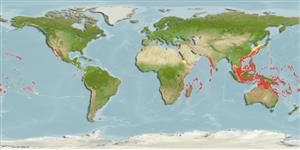
Indo-Pacific: East Africa to Hawaii, throughout Micronesia and Amami Islands, southern Japan.
Tamanho / Peso / Idade
Maturidade: Lm ? range ? - ? cm
Max length : 21.0 cm TL macho/indeterminado; (Ref. 30504)
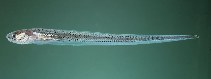
Raios dorsais moles (total) : 35 - 41; Raios anais moles: 54 - 61; Vértebras: 102 - 114. Eel-like, moderate to shallow body depth; cardiform teeth present but restricted to upper jaw symphysis; swim bladder constricted (under vertebrae 9 or 10) forming two chambers; lacking enlarged dentary or premaxillary fangs, dentary diastema, pelvic fins and swim bladder rockerbone (Ref. 34024). Differs from Encheliophis homei by possessing scattered melanophores over most of the body (Ref. 37816).
Body shape (shape guide): eel-like; Cross section: oval.
Common species (Ref. 34024). Found in starfishes (mainly) and holothurians (Ref. 4104), usually in a male - female pair (Ref. 11228). Benthic (Ref. 58302). In Micronesia, it prefers the pincushion starfish Culcita novaeguinae for a host. Also known to occur in certain holothurians (Bohadschia argus, Stichopus sp.) on rare occasions (Ref. 1602); for the first time with Isostichopus fuscus along the coast of Ecuador (Ref. 57700).
Ciclo de vida e comportamento de acasalamento
Maturidade | Reprodução | Desova | Ovos | Fecundidade | Larvas
Nielsen, J.G., D.M. Cohen, D.F. Markle and C.R. Robins, 1999. Ophidiiform fishes of the world (Order Ophidiiformes). An annotated and illustrated catalogue of pearlfishes, cusk-eels, brotulas and other ophidiiform fishes known to date. FAO Fish. Synop. 125(18):178p. Rome: FAO. (Ref. 34024)
Categoria na Lista Vermelha da IUCN (Ref. 130435: Version 2025-2 (Global))
Ameaça para o homem
Harmless
Utilização humana
Pescarias: sem interesse
Ferramentas
Relatórios especiais
Descarregue XML
Fontes da internet
Estimativas baseadas em modelos
Temperatura preferida (Ref.
123201): 23.6 - 28.9, mean 27.6 °C (based on 1346 cells).
Índice de diversidade filogenética (Ref.
82804): PD
50 = 0.5312 [Uniqueness, from 0.5 = low to 2.0 = high].
Bayesian length-weight: a=0.00102 (0.00046 - 0.00225), b=3.06 (2.88 - 3.24), in cm total length, based on all LWR estimates for this body shape (Ref.
93245).
Nível Trófico (Ref.
69278): 3.6 ±0.5 se; based on size and trophs of closest relatives
Vulnerabilidade da pesca (Ref.
59153): Low vulnerability (11 of 100).
🛈