>
Eupercaria/misc (Various families in series Eupercaria) >
Labridae (Wrasses) > Hypsigenyinae
Etymology: Bodianus: Bodianus after Bodiano or Pudiano, from the Portuguese pudor, meaning modesty (Jordan & Evermann, 1896); diana: Named for Diana, the goddess of the chase and the moon, an allusion to the beautiful coloration and form of the species (Ref. 75973).
Eponymy: Diana, the Roman goddess of the chase and the moon; an allusion to the beautiful coloration and form of the species. (Ref. 128868), visit book page.
More on author: Lacepède.
Ambiente: milieu / zona climática / intervalo de profundidade / gama de distribuição
Ecologia
marinhas associadas(os) a recifes; intervalo de profundidade 6 - 80 m (Ref. 90102), usually 6 - 25 m (Ref. 27115). Tropical; 24°C - 28°C (Ref. 27115); 26°N - 34°S, 19°E - 106°E
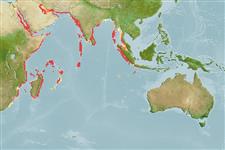
Indian Ocean: East Africa (questionable in the Gulf of Aden and Somalia), east to the Nicobar Islands and Cocos-Keeling Islands (Ref. 75973). Replaced by Bodianus dictynna in the tropical Western Pacific and the longer snouted Bodianus prognathus in the Line Islands (Ref. 37816).
Tamanho / Peso / Idade
Maturidade: Lm ? range ? - ? cm
Max length : 16.9 cm SL macho/indeterminado; (Ref. 75973)
Espinhos dorsais (total) : 12; Raios dorsais moles (total) : 10; Espinhos anais: 3; Raios anais moles: 12. This species is distinguished by the following characters: D XII,10; A III,12; caudal-fin rays 10 - 11 (4) + 12 + 10; pectoral-fin rays ii, 11-15 (3); predorsal scales ?22-25; total gill rakers 15 or 17; head and snout elongate; jaws attenuate; the cheek scales reaching forward on upper side of mouth to below or slightly in advance of anterior extent of orbit, scales reaching forward on lower jaw slightly in advance of posterior corner of mouth; one scale usually apparent midway between corner of mouth and anterior tip of jaw; the upper jaw with first prominent anterior canine equal to or slightly smaller than second; first canine directed anteroventrally, the tip often curved ventrally; second canine directed ventrolaterally and slightly anteriorly, tip occasionally curved ventrally; dental ridge mostly straight with ?6-21 very small canines; one moderately large prominent canine at posterior end of jaw directed anteroventrally and slightly laterally in small individuals, directed more anteriorly in larger specimens; the lower jaw with first prominent anterior canine ?2/3-3/4 length of second; the first canine is directed anterodorsally and usually slightly laterally, tip often curved dorsally; dental ridge usually long and continuous with about 15-22 very small canines in a single row; the teeth becoming only slightly larger posteriorly; teeth occasionally separable into 2 series; the pelvic fin is short, its posterior tip approaching anus only in small individuals (Ref. 75973).
Body shape (shape guide): fusiform / normal; Cross section: compressed.
Adults are found in coral rich areas of seaward reefs (Ref. 5213). Reported to be associated with the mushroom Heliofungia actiniformis (Ref. 91291). Oviparous, distinct pairing during breeding (Ref. 205). Maximum depth reported taken from Ref. 9773.
Ciclo de vida e comportamento de acasalamento
Maturidade | Reprodução | Desova | Ovos | Fecundidade | Larvas
Oviparous, distinct pairing during breeding (Ref. 205).
Gomon, M.F., 2006. A revision of the labrid fish genus Bodianus with descriptions of eight new species. Rec. Aust. Mus. Suppl. 30:1-133. (Ref. 75973)
Categoria na Lista Vermelha da IUCN (Ref. 130435: Version 2025-2 (Global))
Ameaça para o homem
Harmless
Utilização humana
Pescarias: pouco comercial; Aquário: Espécies comerciais
Ferramentas
Relatórios especiais
Descarregue XML
Fontes da internet
Estimativas baseadas em modelos
Temperatura preferida (Ref.
123201): 24.9 - 29, mean 27.3 °C (based on 84 cells).
Índice de diversidade filogenética (Ref.
82804): PD
50 = 0.5000 [Uniqueness, from 0.5 = low to 2.0 = high].
Bayesian length-weight: a=0.01047 (0.00493 - 0.02225), b=3.08 (2.90 - 3.26), in cm total length, based on LWR estimates for this Genus-body shape (Ref.
93245).
Nível Trófico (Ref.
69278): 3.9 ±0.33 se; based on food items.
Resiliência (Ref.
120179): Elevada, tempo mínimo de duplicação da população menor que 15 meses (Preliminary K or Fecundity.).
Vulnerabilidade da pesca (Ref.
59153): Low vulnerability (11 of 100).
🛈
Nutrientes (Ref.
124155): Calcium = 71.1 [43.1, 126.9] mg/100g; Iron = 0.65 [0.38, 1.20] mg/100g; Protein = 18.6 [15.7, 20.8] %; Omega3 = 0.169 [0.108, 0.267] g/100g; Selenium = 25.1 [14.3, 45.9] μg/100g; VitaminA = 161 [48, 617] μg/100g; Zinc = 1.5 [1.0, 2.3] mg/100g (wet weight);