Classificação / Nomes
Nomes comuns | Sinónimos | Catalog of Fishes(Género, Espécies) | ITIS | CoL | WoRMS | Cloffa
>
Anabantiformes (Gouramies, snakeheads) >
Badidae (Chameleonfishes)
Etymology: Badis: 'badis' is presumably a Bengali local name, possibly derived from 'bhedo' or 'bheda', but it lacks a proper reference. Probably incorrect etymology (J. Müller, pers. comm., April 2021, after information from native speakers); andrewraoi: Named for Andrew A. Rao, who discovered, collected and donated the material for this new species. This is in recognition of his substantial contributions to ichthyology. A noun in the masculine genitive singular.
Eponymy: Andrew Arunava Rao is an ornamental-fish collector and breeder who owns and runs Malabar Tropicals. (See Andrew (Rao)) (Ref. 128868), visit book page.
Ambiente: milieu / zona climática / intervalo de profundidade / gama de distribuição
Ecologia
; Água doce pelágico(a,os,as). Tropical
Asia: Balason River, Mahananda River drainage in West Bengal, India.
Tamanho / Peso / Idade
Maturidade: Lm ? range ? - ? cm
Max length : 3.9 cm SL macho/indeterminado; (Ref. 103291)
Descrição breve
Chaves de identificação | Morfologia | Morfometria
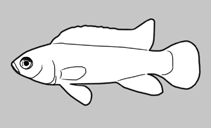
Espinhos dorsais (total) : 15 - 17; Raios dorsais moles (total) : 10; Espinhos anais: 3; Raios anais moles: 7 - 9; Vértebras: 26. Badis andrewraoi possesses a color pattern that distinguishes it from all congeners. It can be discriminated from all members of the B. badis group (B. badis, B. chittagongis, B. dibruensis, B. ferrarisi, B. kanabos, B. soraya and B. tuivaiei) by the absence of a blotch on the superficial part of the cleithrum above pectoral-fin base; from all members of the B. assamensis group (B. assamensis and B. blosyrus) by the absence of an opercular blotch and absence of two parallel rows of dark spots and alternating light and dark stripes along its physique; from all members of the B. ruber group (B. khwae, B. ruber and B. siamensis) by the absence of a cleithral blotch and absence of a blotch on the dorsolateral aspect of the caudal peduncle; from all members of the B. corycaeus group (B. corycaeus and B. pyema) by the absence of an ocellus on the caudal-fin base; from B. kyar by the presence of a conspicuous median black blotch on the caudal peduncle; from B. singenensis by the absence of a posterodorsal opercle blotch and absence of three dorsal-fin blotches and a single round blotch on the anal-fin base; from B. juergenschmidti by theabsence of white margins on dorsal and ventral aspects of the caudal fin in males and presence of a strongly curved caudal-fin base bar; and from B. britzi by the presence of a conspicuous median black blotch on the caudal peduncle. Other diagnostic characters useful to differentiate B. andrewraoi from other congeners include the presence of side bar on its nape (vs. absence in all other species except B. ferrarisi, B. juergenschmidti, in some B. soraya, B. autumnum and B. kyanos), and a medially broader posterior-most bar, displaying as a partially absorbed second median caudal peduncle blotch (vs. absence in all species except B. autumnum and B. kyanos). It is most closely resembles B. autumnum and B. kyanos in terms of color pattern but it can be distinguished from B. autumnum by the absence of a conspicuous dark blotch on pectoral-fin base, absence of a blotch above the base of the opercular spine, vertical bars restricted to lower half of body (vs. bars 1 to 3 often conspicuous and complete, remaining bars fainter and strongly reduced, present only dorsolaterally), absence of a black caudal-fin margin, outlining entire fin, and by having 18 circumpeduncular scales (vs. 16-18). It differs from B. kyanos by the presence of vertical bars restricted to lower half of body (vs. forming large, fragmented black blocks dorsolaterally and entrolaterally or bars reduced and present only dorsolaterally), and a pale color pattern when stressed (vs. a dark grey body, a metallic dark blue operculum, with flanks almost entirely devoid of bars, and large, fragmented black blocks dorsolaterally), and having 26 lateral row scales modally (vs. 25) (Ref. 103291).
Body shape (shape guide): fusiform / normal.
Occurs in a medium-sized river with a sand substrate (Ref. 103291).
Ciclo de vida e comportamento de acasalamento
Maturidade | Reprodução | Desova | Ovos | Fecundidade | Larvas
Valdesalici, S. and S. Van Der Voort, 2015. Four new species of the Indo-Burmese genus Badis from West Bengal, India (Actinopterygii: Perciformes: Badidae). Zootaxa 3985(3):391-408. (Ref. 103291)
Categoria na Lista Vermelha da IUCN (Ref. 130435: Version 2025-2 (Global))
Ameaça para o homem
Harmless
Utilização humana
Ferramentas
Relatórios especiais
Descarregue XML
Fontes da internet
Estimativas baseadas em modelos
Índice de diversidade filogenética (Ref.
82804): PD
50 = 0.5000 [Uniqueness, from 0.5 = low to 2.0 = high].
Bayesian length-weight: a=0.01175 (0.00503 - 0.02745), b=2.93 (2.73 - 3.13), in cm total length, based on LWR estimates for this (Sub)family-body shape (Ref.
93245).
Nível Trófico (Ref.
69278): 3.2 ±0.4 se; based on size and trophs of closest relatives
Vulnerabilidade da pesca (Ref.
59153): Low vulnerability (10 of 100).
🛈