>
Scombriformes (Mackerels) >
Scombridae (Mackerels, tunas, bonitos) > Scombrinae
Etymology: Auxis: Greek, auxis = a variety of tunna (Ref. 45335).
Eponymy: Dr François-Etienne de la Roche (or Delaroche) (1780–1813) was a Swiss physician, chemist, botanist and ichthyologist, who qualified as a physician in Paris (1808) and worked at the Hospice Necker. [...] (Ref. 128868), visit book page.
More on author: Risso.
Ambiente: milieu / zona climática / intervalo de profundidade / gama de distribuição
Ecologia
marinhas; estuarina pelagic-neritic; oceanódromo (Ref. 71039); intervalo de profundidade 10 - ? m (Ref. 9340). Tropical; ? - 28°C (Ref. 168); 61°N - 51°S, 180°W - 180°E
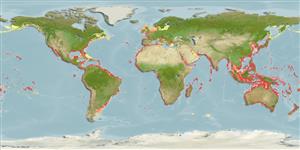
Atlantic, Indian and Pacific (Western): including the Mediterranean Sea. The eastern Pacific population is recognized as subspecies Auxis rochei eudorax (Ref. 32349). Highly migratory species.
Comprimento na primeira maturidade / Tamanho / Peso / Idade
Maturidade: Lm ?, range 35 - ? cm
Max length : 50.0 cm FL macho/indeterminado; (Ref. 168); Idade máx. registada: 5 anos (Ref. 125574)
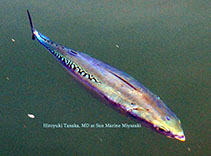
Espinhos dorsais (total) : 9 - 12; Raios dorsais moles (total) : 10 - 13; Espinhos anais: 0; Raios anais moles: 12 - 14. Back bluish, turning to deep purple or almost black on head. Scaleless area with pattern of 15 or more fairly broad, nearly vertical dark bars. Belly white. Pectoral and pelvic fins purple, their inner sides black. Body robust, elongate and rounded. Teeth small and conical, in a single series. Pectoral fins short, not reaching vertical line from anterior margin of scaleless area above corselet. A large, single-pointed flap (interpelvic process) between pelvic fins. Body naked except for corselet, which is well developed in its posterior part 9 more than 6 scales wide under second dorsal-fin origin). A strong central keel on each side of caudal-fin base between 2 smaller keels (Ref 9684).
Body shape (shape guide): fusiform / normal; Cross section: oval.
Adults are principally caught in coastal waters and around islands (Ref. 9340). Form schools. Feed on small fishes, particularly anchovies, crustaceans (especially crab and stomatopod larvae) and squids. Eggs and larvae are pelagic (Ref. 6769). Because of their abundance, they are considered an important element of the food web, particularly as forage for other species of commercial interest. Also caught with encircling nets and troll lines (Ref. 9340). Marketed fresh and frozen (Ref. 9340) and also dried or salted, smoked and canned (Ref. 9987).
Fecundity ranges between 31,000 and 103,000 eggs per spawning according to the size of the fish.
Collette, B.B. and C.R. Aadland, 1996. Revision of the frigate tunas (Scombridae, Auxis), with descriptions of two new subspecies from the eastern Pacific. Fish. Bull. 94(3):423-441. (Ref. 32349)
Categoria na Lista Vermelha da IUCN (Ref. 130435: Version 2025-2 (Global))
Ameaça para o homem
Harmless
Utilização humana
Pescarias: altamente comercial; peixe desportivo: sim
Ferramentas
Relatórios especiais
Descarregue XML
Fontes da internet
Estimativas baseadas em modelos
Temperatura preferida (Ref.
123201): 13.6 - 29, mean 26 °C (based on 6786 cells).
Índice de diversidade filogenética (Ref.
82804): PD
50 = 0.5625 [Uniqueness, from 0.5 = low to 2.0 = high].
Bayesian length-weight: a=0.00933 (0.00808 - 0.01077), b=3.06 (3.02 - 3.10), in cm total length, based on LWR estimates for this species (Ref.
93245).
Nível Trófico (Ref.
69278): 4.4 ±0.61 se; based on food items.
Generation time: 1.8 (1.6 - 3.4) years. Estimated as median ln(3)/K based on 12
growth studies.
Resiliência (Ref.
120179): Médio, tempo mínimo de duplicação da população 1,4 - 4,4 anos (K=0.47; tm).
Prior r = 0.96, 95% CL = 0.64 - 1.45, Based on 1 full stock assessment.
Vulnerabilidade da pesca (Ref.
59153): Low to moderate vulnerability (27 of 100).
🛈
Vulnerabilidade climática (Ref.
125649): Moderate vulnerability (38 of 100).
🛈
Nutrientes (Ref.
124155): Calcium = 198 [57, 462] mg/100g; Iron = 2.28 [0.85, 5.87] mg/100g; Protein = 21.7 [19.6, 23.6] %; Omega3 = 0.364 [0.173, 0.759] g/100g; Selenium = 49.2 [18.5, 153.0] μg/100g; VitaminA = 32.7 [6.9, 148.1] μg/100g; Zinc = 1.46 [0.47, 2.70] mg/100g (wet weight); based on
nutrient studies.