Classificação / Nomes
Nomes comuns | Sinónimos | Catalog of Fishes(Género, Espécies) | ITIS | CoL | WoRMS | Cloffa
>
Cyprinodontiformes (Rivulines, killifishes and live bearers) >
Nothobranchiidae (African rivulines)
Etymology: Aphyosemion: Greek, aphye, -es, sardine, anchovy + Greek, semeion = mark, signal (Ref. 45335); campomaanense: The species name is derived from Campo-Ma’an, in reference to its origin in the Campo-Ma’an National Park, southwestern Cameroon (Ref. 80559).
Ambiente: milieu / zona climática / intervalo de profundidade / gama de distribuição
Ecologia
; Água doce pelágico(a,os,as). Tropical; 3°N - 2°N, 10°E - 11°E
Africa: Ntem River basin in the Campo-Ma'an region, southern Cameroon (Ref. 80559).
Tamanho / Peso / Idade
Maturidade: Lm ? range ? - ? cm
Max length : 4.1 cm SL macho/indeterminado; (Ref. 80559); 5.5 cm SL (female)
Descrição breve
Chaves de identificação | Morfologia | Morfometria
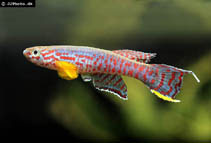
Espinhos dorsais (total) : 0; Raios dorsais moles (total) : 10 - 11; Espinhos anais: 0; Raios anais moles: 13 - 14. Diagnosis: Aphyosemion campomaanense is distinguished from congeners by a combination of coloration characteristics (Ref. 80559). It is distinguished from A. ahli by a much more pronounced and darker blue background colour; the background colour is here defined as the colour that covers the majority of the body; in addition, A. ahli has a caudal fin with symmetric colouration while in A. campomaanense the caudal fin colouration is asymmetrical with a yellow lower margin and a white upper margin, vs. red and yellow margins in A. ahli; and the pectoral fins in A. campomaanense are deep orange vs. pale yellow in A. ahli (Ref. 80559). Aphyosemion campomaanense is distinguished from A. lividum by striped dorsal and anal fins vs. unstriped fins; and red dots aligned like vertical stripes posteriorly vs. no red punctuation posteriorly (Ref. 80559). It is distinguished from A. edeanum by an obvious blue vs. reddish background colour; asymmetric caudal fin colouration with a yellow lower margin and a white upper margin vs. red and yellow margins; and deep orange pectoral fins vs. transparent or pale blue (Ref. 80559). It can be distinguished from A. heinemanni by a more pronounced blue background colour; asymmetric caudal-fin colouration with a yellow lower margin and a white upper margin vs. a semicircular red sub-margin on a rounded caudal fin; and the presence of red dots on the anal fin vs. no dots (Ref. 80559). It can be distinguished from A. pascheni pascheni and A. paschane festivum by the presence of vertically aligned red dots in the posterior vs. scattered weak red spotting; red dots on the anal fin vs. no dots; red stripes on the dorsal fin vs. no stripes; yellow lower margins vs. white on the anal and caudal fins; and red vertical stripes on the caudal fin vs. a series of red dots or straight lines or series of dots along rays (Ref. 80559).
Body shape (shape guide): fusiform / normal.
Usually found in small streams and shallow pools in the rainforest; they stay close to the banks, avoiding the deepest and fastest water (Ref. 80559).
Ciclo de vida e comportamento de acasalamento
Maturidade | Reprodução | Desova | Ovos | Fecundidade | Larvas
Agnèse, J.-F., R. Brummett, P. Caminade, J. Catalan and E. Kornobis, 2009. Genetic characterization of the Aphyosemion calliurum species group and description of a new species from this assemblage: A. campomaanense (Cyprinodontiformes: Aplocheiloidei: Nothobranchiidae) from southern Cameroon. Zootaxa 2045:43-59. (Ref. 80559)
Categoria na Lista Vermelha da IUCN (Ref. 130435: Version 2025-2 (Global))
Ameaça para o homem
Harmless
Utilização humana
Ferramentas
Relatórios especiais
Descarregue XML
Fontes da internet
Estimativas baseadas em modelos
Índice de diversidade filogenética (Ref.
82804): PD
50 = 0.5000 [Uniqueness, from 0.5 = low to 2.0 = high].
Bayesian length-weight: a=0.01096 (0.00461 - 0.02608), b=2.94 (2.74 - 3.14), in cm total length, based on LWR estimates for this (Sub)family-body shape (Ref.
93245).
Nível Trófico (Ref.
69278): 3.3 ±0.5 se; based on size and trophs of closest relatives
Vulnerabilidade da pesca (Ref.
59153): Low vulnerability (10 of 100).
🛈