Ambiente: milieu / zona climática / intervalo de profundidade / gama de distribuição
Ecologia
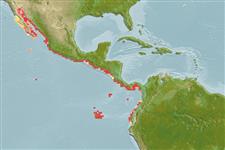
marinhas pelagic-neritic; intervalo de profundidade 0 - 50 m (Ref. 189). Tropical; 33°N - 3°S, 116°W - 77°W (Ref. 189)
Eastern Central Pacific: southwestern coast of Baja California, Mexico and the Gulf of California to Panama and the Galápagos Islands.
Tamanho / Peso / Idade
Maturidade: Lm ? range ? - ? cm
Max length : 17.0 cm TL macho/indeterminado; (Ref. 114986); common length : 9.5 cm SL macho/indeterminado; (Ref. 9298)
Descrição breve
Chaves de identificação | Morfologia | Morfometria
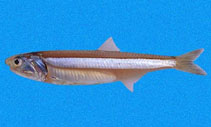
Espinhos dorsais (total) : 0; Espinhos anais: 0; Raios anais moles: 15 - 19. Body rather elongate, but somewhat compressed. Snout moderate, about 3/4 eye diameter; maxilla moderate, tip narrowly pointed, reaching onto sub-operculum, but not to edge of gill cover; gill cover canals of panamensis-type. Anal fin short, its origin below posterior third of dorsal fin base. A narrow silver stripe along flank, deeper above anal fin (about 3/4 to 2/3 eye diameter).
Body shape (shape guide): elongated; Cross section: oval.
A schooling species occurring in coastal waters. Pelagic. Frequently caught over sand or gravel in the Gulf of Nicoya, Costa Rica, but also over mud.
Ciclo de vida e comportamento de acasalamento
Maturidade | Reprodução | Desova | Ovos | Fecundidade | Larvas
May spawn throughout the year in the Gulf of Nicoya, Costa Rica (Ref. 189). Spawn in school (Ref. 205).
Whitehead, P.J.P., G.J. Nelson and T. Wongratana, 1988. FAO Species Catalogue. Vol. 7. Clupeoid fishes of the world (Suborder Clupeoidei). An annotated and illustrated catalogue of the herrings, sardines, pilchards, sprats, shads, anchovies and wolf-herrings. FAO Fish. Synop. 125(7/2):305-579. Rome: FAO. (Ref. 189)
Categoria na Lista Vermelha da IUCN (Ref. 130435: Version 2025-2 (Global))
Ameaça para o homem
Harmless
Utilização humana
Pescarias: pescarias de subsistência
Ferramentas
Relatórios especiais
Descarregue XML
Fontes da internet
Estimativas baseadas em modelos
Temperatura preferida (Ref.
123201): 20.6 - 28.5, mean 25.8 °C (based on 60 cells).
Índice de diversidade filogenética (Ref.
82804): PD
50 = 0.5000 [Uniqueness, from 0.5 = low to 2.0 = high].
Bayesian length-weight: a=0.00589 (0.00358 - 0.00967), b=3.14 (3.01 - 3.27), in cm total length, based on LWR estimates for this species & Genus-body shape (Ref.
93245).
Nível Trófico (Ref.
69278): 3.4 ±0.4 se; based on size and trophs of closest relatives
Resiliência (Ref.
120179): Elevada, tempo mínimo de duplicação da população menor que 15 meses (Preliminary K or Fecundity.).
Vulnerabilidade da pesca (Ref.
59153): Low vulnerability (10 of 100).
🛈