>
Cypriniformes (Carps) >
Leuciscidae (Minnows) > Leuciscinae
Etymology: Alburnoides: From the city of Al Bura, where the fish was known + particle Greek, oides = similar (Ref. 45335).
More on author: Bloch.
Taxonomic Remarks
Junior synonym Alburnoides tzanevi is valid in the Catalog of Fishes (ver. 05 July 2022); reference needed.
Lingkungan: lingkungan / zona iklim / kisaran kedalaman / jangkauan distribusi
Ekologi
; air tawar; payau bentopelagis; pH range: 7.0 - 8.0; potamodromous (Ref. 51243). Subtropical; 10°C - 18°C (Ref. 1672); 61°N - 34°N, 5°W - 74°E
Europe and Asia: Loire drainage in France eastward, in nearly all rivers draining to southern Baltic, North, Black and Azov Seas; Caspian basin, in upper Volga and from Kura drainage southward to Iranian tributaries of Caspian; widespread in Iran. In Mediterannean basin, only in Rhône and some small coastal drainages from Provence (France) eastward to Genova (Italy), Aoos (Greece, Albania) and western Greece as far south as Sperchios drainage. In Marmara basin, western Anatolia south to Great Menderes drainage and in upper Euphrate and Tigris drainages. Aral basin, upper Amu Darja and Karakumskij drainages (Tukmenistan, Afghanistan).
Ukuran / Berat / umur
Kematangan: Lm ? range ? - ? cm
Max length : 18.5 cm TL jantan/; (Ref. 88163); common length : 9.0 cm TL jantan/; (Ref. 556); Berat maksimum terpublikasi: 30.00 g (Ref. 30578)
deskripsi pendek
Kunci identifiaksi (pengenalan) | Morfologi | Morfometrik
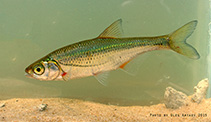
Duri punggung (Keseluruhan (total)) : 3; duri punggung lunak (Keseluruhan (total)) : 7 - 8; Duri dubur: 3; Sirip dubur lunak: 13 - 18; vertebrata, bertulang belakang: 38 - 40. Diagnosed from its congeners in Europe by following characters: anal fin with 12-17½ branched rays; snout length equal to or smaller than eye diameter; eye diameter about equal to interorbital distance; and mouth terminal (Ref. 59043). Caudal fin with 19 rays (Ref. 2196).
Body shape (shape guide): fusiform / normal.
Inhabit streams and rivers in foothills with well oxygenated, fast-flowing water. All age classes occur in open water of streams and small rivers (Ref. 59043). Found also in rivers with very calm waters. Feed on insect larvae and dead insects (Ref. 9696), as well as on crustaceans and diatoms. Spawn in small groups and lay eggs deep into gravel with swift current. Locally threatened by stream regulation, trout stocking and pollution. Attain a maximum size of up to about 13 cm SL (Ref. 59043).
Spawns in small groups and deposit eggs deep into gravel (Ref. 59043).
Kottelat, M. and J. Freyhof, 2007. Handbook of European freshwater fishes. Publications Kottelat, Cornol and Freyhof, Berlin. 646 pp. (Ref. 59043)
Status IUCN Red List (Ref. 130435: Version 2025-2 (Global))
ancaman kepada manusia
Harmless
penggunaan manusia
Perikanan: tidak ada kepentingan; Akuarium: Komersial; umpan: usually
Alat, peralatan
laporan khas
muat turun XML
Sumber internet
Estimasi berdasarkan model
Indeks keanekaragaman filogenetik (Acuan
82804): PD
50 = 0.5000 [Uniqueness, from 0.5 = low to 2.0 = high].
Bayesian length-weight: a=0.00708 (0.00559 - 0.00896), b=3.14 (3.11 - 3.17), in cm total length, based on LWR estimates for this species (Ref.
93245).
Tingkat Trofik (Acuan
69278): 2.9 ±0.35 se; based on food items.
Generation time: 3.9 (3.1 - 5.8) years. Estimated as median ln(3)/K based on 13
growth studies.
Daya lenting (Acuan
120179): sedang, Waktu penggandaan populasi minimum 1.4 - 4.4 tahun (K=0.36; tmax=6; Fec>10,000).
Kerentanan Penangkapan Ikan (Ref.
59153): Low to moderate vulnerability (34 of 100).
🛈