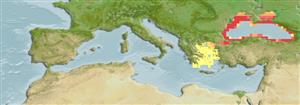
Ambiente: milieu / zona climática / intervalo de profundidade / gama de distribuição
Ecologia
marinhas; Água doce; estuarina demersal; anádromo (Ref. 138126); intervalo de profundidade 10 - 100 m. Temperate; 10°C - 20°C (Ref. 2059); 61°N - 36°N, 13°E - 54°E
Eurasia: Caspian, Black, Azov and Aegean Seas, ascending rivers to spawn. Occurrence in Albania needs confirmation. Introduced in Aral Sea. Artificially propagated (Ref. 6866). Probably extirpated from Aegean Sea and related river basins (Ref. 113969).
Comprimento na primeira maturidade / Tamanho / Peso / Idade
Maturidade: Lm ?, range 120 - ? cm
Max length : 250 cm TL macho/indeterminado; (Ref. 98365); common length : 125 cm TL macho/indeterminado; (Ref. 3397); peso máx. Publicado: 80.0 kg (Ref. 9988); Idade máx. registada: 29 anos (Ref. 126409)
Espinhos dorsais (total) : 0; Raios dorsais moles (total) : 40 - 46; Raios anais moles: 24 - 29. Snout long, pointed at tip. Lower lip not continuous, interrupted at center. Barbels short not reaching mouth but nearer to it than to tip of snout. Five rows of scutes, dorsal 11-14, lateral 30-36 on each side, ventral 10-11 on each side, with small bony stellate plates and smaller grains between main scute rows. Back dark grey to almost black, flanks lighter, belly white.
Body shape (shape guide): elongated; Cross section: circular.
At the sea, it occurs in coastal and estuarine zones and forages on the bottom mostly on clayey sand and intensively in the middle and upper water layers (Ref. 59043). Found mainly near shore over sand and mud, stays at the bottom during the day and rises to the surface to feed at night. Feeds mainly on fish, also mollusks, crustaceans and worms (Ref. 3193). Spawns in strong-current habitats in main course of large and deep rivers, on stone or gravel bottom. Spawning also takes place on flooded river banks and if gravel bottom is not available, on sand or sandy clay. Juveniles stay in shallow riverine habitats during first summer (Ref. 59043). One of the three most important species for caviar; also utilized fresh and frozen; eaten pan-fried, broiled and baked (Ref. 9988). Overfishing at the sea for meat and caviar will soon cause extinction of the natural populations and their survival can only depend on stocking (Ref. 59043).
Bauchot, M.-L., 1987. Poissons osseux. p. 891-1421. In W. Fischer, M.L. Bauchot and M. Schneider (eds.) Fiches FAO d'identification pour les besoins de la pêche. (rev. 1). Méditerranée et mer Noire. Zone de pêche 37. Vol. II. Commission des Communautés Européennes and FAO, Rome. (Ref. 3397)
Categoria na Lista Vermelha da IUCN (Ref. 130435: Version 2025-2 (Global))
Ameaça para o homem
Harmless
Utilização humana
Pescarias: espécies comerciais; Aquacultura: espécies comerciais; Aquário: Aquários públicos
Ferramentas
Relatórios especiais
Descarregue XML
Fontes da internet
Estimativas baseadas em modelos
Temperatura preferida (Ref.
123201): 7.6 - 15.9, mean 13.1 °C (based on 66 cells).
Índice de diversidade filogenética (Ref.
82804): PD
50 = 0.5000 [Uniqueness, from 0.5 = low to 2.0 = high].
Bayesian length-weight: a=0.00537 (0.00328 - 0.00878), b=3.04 (2.90 - 3.18), in cm total length, based on LWR estimates for this species & Genus-body shape (Ref.
93245).
Nível Trófico (Ref.
69278): 3.5 ±0.2 se; based on diet studies.
Resiliência (Ref.
120179): Baixo, tempo mínimo de duplicação da população 4,5 - 14 anos (K=0.06; tm=9; tmax=29; Fec=20,000-360,000).
Vulnerabilidade da pesca (Ref.
59153): Very high vulnerability (85 of 100).
🛈
Vulnerabilidade climática (Ref.
125649): Moderate to high vulnerability (51 of 100).
🛈
Nutrientes (Ref.
124155): Calcium = 16.8 [10.4, 28.3] mg/100g; Iron = 0.271 [0.168, 0.429] mg/100g; Protein = 17.8 [15.3, 20.4] %; Omega3 = 0.385 [0.222, 0.665] g/100g; Selenium = 23.5 [13.0, 45.4] μg/100g; VitaminA = 4.05 [1.55, 10.74] μg/100g; Zinc = 0.409 [0.299, 0.552] mg/100g (wet weight);