>
Pleuronectiformes (Flatfishes) >
Cyclopsettidae (Sand whiffs)
Etymology: Cyclopsetta: Greek, kyklos = round + Greek, psetta = grouper (Ref. 45335).
Eponymy: Dr John Franks Chittenden (1843–1895) was an English physician who moved to the West Indies (1871). [...] (Ref. 128868), visit book page.
Ambiente: milieu / zona climática / intervalo de profundidade / gama de distribuição
Ecologia
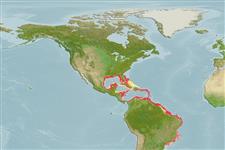
marinhas demersal; intervalo de profundidade 20 - 150 m (Ref. 5217). Subtropical; 30°N - 26°S, 98°W - 34°W
Western Atlantic: northwestern Gulf of Mexico to Brazil.
Tamanho / Peso / Idade
Maturidade: Lm ? range ? - ? cm
Max length : 39.0 cm TL macho/indeterminado; (Ref. 131022); common length : 25.0 cm TL macho/indeterminado; (Ref. 3275); peso máx. Publicado: 513.00 g (Ref. 131022)
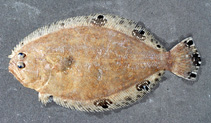
Espinhos dorsais (total) : 0; Raios dorsais moles (total) : 82 - 90; Espinhos anais: 0; Raios anais moles: 63 - 69. Body is oval, moderately elongate. Dorsal fin originates distinctly anterior to a vertical at front of the eyes. Eyes on left side, not large, their diameter is 5 - 5.9 times the head length. The interorbital space is narrow, less than half the eye diameter. Lateral line on eyed side is not steeply arched above pectoral fin. The mouth is large extending slightly beyond the posterior margin of the eyes. Caudal fin is rounded. Color is brown with a large blotch beneath pectoral fin. The dorsal and anal fins have a row of dark spots containing pale areas,. Two spots on the dorsal and a few on the anal are large. The caudal fin has three large dark spots at the posterior border, none on center of the fin. Number of ovaries: 2. Ovaries are symmetrical, lie parallel with each other, depressed cross-sectionally and extra-visceral in location (Ref. 101557).
Body shape (shape guide): short and / or deep; Cross section: flattened.
Occurs in bays, lagoons and shallow coastal waters. Found on soft bottoms (Ref. 5217). Marketed fresh (Ref. 5217).
Ciclo de vida e comportamento de acasalamento
Maturidade | Reprodução | Desova | Ovos | Fecundidade | Larvas
Distinct pairing (Ref. 205). Number of ovaries: 2. Ovaries are symmetrical, lie parallel with each other, depressed cross-sectionally and extra-visceral in location (Ref. 101557).
Robins, C.R. and G.C. Ray, 1986. A field guide to Atlantic coast fishes of North America. Houghton Mifflin Company, Boston, U.S.A. 354 p. (Ref. 7251)
Categoria na Lista Vermelha da IUCN (Ref. 130435: Version 2025-2 (Global))
Ameaça para o homem
Harmless
Utilização humana
Pescarias: pouco comercial
Ferramentas
Relatórios especiais
Descarregue XML
Fontes da internet
Estimativas baseadas em modelos
Temperatura preferida (Ref.
123201): 19.6 - 27.4, mean 24.8 °C (based on 192 cells).
Índice de diversidade filogenética (Ref.
82804): PD
50 = 0.5625 [Uniqueness, from 0.5 = low to 2.0 = high].
Bayesian length-weight: a=0.00851 (0.00518 - 0.01398), b=3.10 (2.96 - 3.24), in cm total length, based on LWR estimates for this species & (Sub)family-body (Ref.
93245).
Nível Trófico (Ref.
69278): 4.2 ±0.7 se; based on size and trophs of closest relatives
Generation time: 1.4 ( na - na) years. Estimated as median ln(3)/K based on 1
growth studies.
Resiliência (Ref.
120179): Elevada, tempo mínimo de duplicação da população menor que 15 meses (K=0.78).
Vulnerabilidade da pesca (Ref.
59153): Low vulnerability (21 of 100).
🛈