Elasmobranchii (tubarões e raias) (sharks and rays) >
Rajiformes (Skates and rays) >
Rajidae (Skates)
Etymology: Rajella: Latin, raja, -ae = a sting ray (Raja sp.) (Ref. 45335).
Taxonomic Remarks
Specific name amended to R. leoparda in accordance with ICZN Article 34.2 by Weigmann et al., 2014 (Ref.96993).
Ambiente: milieu / zona climática / intervalo de profundidade / gama de distribuição
Ecologia
marinhas batidemersal; intervalo de profundidade 130 - 1920 m (Ref. 106604). Deep-water; - 36°S
Eastern Atlantic: off eastern and western South Africa to off Mauritania
Tamanho / Peso / Idade
Maturidade: Lm ? range ? - ? cm
Max length : 95.0 cm TL macho/indeterminado; (Ref. 106604)
Descrição breve
Chaves de identificação | Morfologia | Morfometria
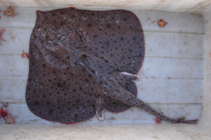
Large skate with a moderately long snout, small eyes, and a flat disc; tail about as long as body; small inconspicuous, light thorns on upper surface including snout (Ref. 5578). Medium grey to brownish dorsally, often with dark spots; white or mottled with dusky patches ventrally (Ref. 5578).
Body shape (shape guide): other.
Found in deeper shelf and slope waters (Ref. 4426). Feed on bottom crustaceans, dragonets, rattails, hake, lanternfish, sea pens, cuttlefish and polychaete worms (Ref. 5578). Oviparous. Distinct pairing with embrace. Young may tend to follow large objects, such as their mother (Ref. 205). Eggs are oblong capsules with stiff pointed horns at the corners deposited in sandy or muddy flats (Ref. 205). Egg capsules are 7.4 cm long and 7.4 cm wide (Ref. 41249). Caught by hake trawlers (Ref. 5578).
Ciclo de vida e comportamento de acasalamento
Maturidade | Reprodução | Desova | Ovos | Fecundidade | Larvas
Oviparous, paired eggs are laid. Embryos feed solely on yolk (Ref. 50449). Distinct pairing with embrace. Young may tend to follow large objects, such as their mother (Ref. 205).
McEachran, J.D. and K.A. Dunn, 1998. Phylogenetic analysis of skates, a morphologically conservative clade of elasmobranchs (Chondrichthyes: Rajidae). Copeia 1998(2):271-290. (Ref. 27314)
Categoria na Lista Vermelha da IUCN (Ref. 130435: Version 2025-2 (Global))
Ameaça para o homem
Harmless
Utilização humana
Pescarias: espécies comerciais
Ferramentas
Relatórios especiais
Descarregue XML
Fontes da internet
Estimativas baseadas em modelos
Temperatura preferida (Ref.
123201): 4.1 - 11.9, mean 6.9 °C (based on 47 cells).
Índice de diversidade filogenética (Ref.
82804): PD
50 = 0.5000 [Uniqueness, from 0.5 = low to 2.0 = high].
Bayesian length-weight: a=0.00316 (0.00192 - 0.00522), b=3.32 (3.18 - 3.46), in cm total length, based on LWR estimates for this species & (Sub)family-body (Ref.
93245).
Nível Trófico (Ref.
69278): 3.9 ±0.63 se; based on food items.
Resiliência (Ref.
120179): Baixo, tempo mínimo de duplicação da população 4,5 - 14 anos (Fec assumed to be <100).
Vulnerabilidade da pesca (Ref.
59153): High vulnerability (58 of 100).
🛈
Nutrientes (Ref.
124155): Calcium = 9.71 [1.80, 49.75] mg/100g; Iron = 0.404 [0.092, 1.262] mg/100g; Protein = 16.5 [13.7, 19.1] %; Omega3 = 0.644 [0.200, 2.420] g/100g; Selenium = 14.5 [3.8, 46.2] μg/100g; VitaminA = 13 [3, 56] μg/100g; Zinc = 0.299 [0.147, 0.566] mg/100g (wet weight);