>
Salmoniformes (Salmons) >
Salmonidae (Salmonids) > Salmoninae
Etymology: Salmo: Latin, salmo, Plinius = salmon (Ref. 45335); multipunctatus: The species name multipunctata [to be corrected in multipunctatus refers to its diagnostic pigmentation pattern, which is consttuted by numerous spots and marks along the body (Ref. 107622).
Ambiente: milieu / zona climática / intervalo de profundidade / gama de distribuição
Ecologia
; Água doce pelágico(a,os,as). Subtropical
Africa: Draa basin in southern Morocco (Ref. 107622).
Tamanho / Peso / Idade
Maturidade: Lm ? range ? - ? cm
Max length : 16.2 cm SL macho/indeterminado; (Ref. 107622)
Descrição breve
Chaves de identificação | Morfologia | Morfometria
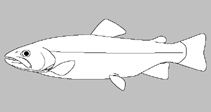
Vértebras: 53 - 55. Diagnosis: It differs from other known species of the genus Salmo in the numerous irregular narrow parr marks, usually more than or equal to 14, in the lateral line; upper row of parr marks more than or equal to 10; lower row of parr marks variable, usually more than or equal to 5; two conspicuous black spots placed at the right and left sides of the iris and two less visible spots at the upper and lower sides of the iris; numerous black, small spots at the upper side of the body and several red ocellated and non-ocellated spots placed in the middle of the body; black spots sometimes extended to the opercular region and the caudal fin; ethmoid bone with a characteristic T shape; premaxilla bone with small and inclined upper process; from 14-16 scales from base of adipose fin to lateral line; from 12-14 dorsal fin pterygophores; and 9 molecular autopomorphies in MT-CYTB gene in the nucleotide positions 60, 216,474, 504, 732, 849, 915, 990, 1090 (Ref. 107622).
Body shape (shape guide): fusiform / normal; Cross section: oval.
This species inhabits small and shallow streams with clear and cold waters (Ref. 107622). The habitat of this species suffers catastrophic seasonal floods that influence dramatically the demography of the population; the continuous deforestation of the Atlas Mountains and the disappearance of the riparian vegetation, increase the adverse effect of the overflows over the small Atlas rivers; overfishing is also a problem for a small population ; therefore this species should be included in the IUCN category of endangered (Ref. 107622).
Ciclo de vida e comportamento de acasalamento
Maturidade | Reprodução | Desova | Ovos | Fecundidade | Larvas
Doadrio, I., S. Perea and A. Yahyaoui, 2015. Two new species of Atlantic trout (Actinopterygii, Salmonidae) from Morocco. Graellsia 71(2,e039):1-26. (Ref. 107622)
Categoria na Lista Vermelha da IUCN (Ref. 130435: Version 2025-2 (Global))
Ameaça para o homem
Harmless
Utilização humana
Pescarias: espécies comerciais
Ferramentas
Relatórios especiais
Descarregue XML
Fontes da internet
Estimativas baseadas em modelos
Índice de diversidade filogenética (Ref.
82804): PD
50 = 0.5000 [Uniqueness, from 0.5 = low to 2.0 = high].
Bayesian length-weight: a=0.01047 (0.00486 - 0.02255), b=3.03 (2.86 - 3.20), in cm total length, based on LWR estimates for this Genus-body shape (Ref.
93245).
Nível Trófico (Ref.
69278): 3.4 ±0.4 se; based on size and trophs of closest relatives
Resiliência (Ref.
120179): Elevada, tempo mínimo de duplicação da população menor que 15 meses (Preliminary K or Fecundity.).
Vulnerabilidade da pesca (Ref.
59153): Low vulnerability (10 of 100).
🛈