>
Cypriniformes (Carps) >
Sundadanionidae (Tiny danios)
Etymology: Sundadanio: Sunda: Asiatic island; Danio: from ‘dhani’, local Bengali/Bangla name for small minnows (Ref. 2031); echinus: From the Latin 'echinus', meaning hedgehog. This is in reference to the large, spiny tubercles on the lower jaw of Sundadanio, which were first discovered in this species. A noun in apposition.
More on authors: Conway, Kottelat & Tan.
Ambiente: milieu / zona climática / intervalo de profundidade / gama de distribuição
Ecologia
; Água doce bentopelágico. Tropical
Asia: peat swamp forests of the vicinity of Anjungan and Kepayan in West Kalimantan, Indonesia. Pictures of Sundadanio from western Sarawak that have been tentatively identified as Sundadanio echinus may indicate that this species may have a wider distribution than is known presently.
Tamanho / Peso / Idade
Maturidade: Lm ? range ? - ? cm
Max length : 2.1 cm SL macho/indeterminado; (Ref. 88800)
Descrição breve
Chaves de identificação | Morfologia | Morfometria
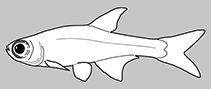
Raios dorsais moles (total) : 9; Raios anais moles: 9; Vértebras: 34 - 35. Distinguished from all congeners by its snout length, 15-19% HL and body depth at pelvic-fin origin, 25-30 % SL. Differs from all other species, except Sundadnio rubellus, by the presence of the secondary lateral stripe in both sexes. Can be further diagnosed by following combination of characters: large adult body size (largest specimen examined 17.8 mm SL); live males with emerald green sheen present across dorsal body surface, an intense red secondary lateral stripe, running along ventral edge of emerald green sheen from posterior to opercular opening to point opposite middle of anal fin, and an intense black marking across anterior portion of anal fin; preserved males with a well developed dark lateral stripe of roughly uniform depth along entire length, horizontal through ventral border of which, when brought forward, extending through dorsal half of eye; presence of a distinctive secondary lateral stripe of small melanophores running parallel to dark lateral stripe along its ventral margin from posterior to opercular opening to point opposite middle of anal fin; presence of reticulate pattern along dorsal body surface posterior to dorsal-fin origin; absence of dusky markings on dorsal and caudal fins; presence of enlarged scales next to window in body musculature; complete covering of scales on caudal peduncle; scales posterior to enlarged scales next to window in body musculature and anterior to anal-fin origin with a single small tubercle at center (Ref. 88800).
Body shape (shape guide): fusiform / normal.
Inhabits peat swamp forests (Ref. 88800).
Ciclo de vida e comportamento de acasalamento
Maturidade | Reprodução | Desova | Ovos | Fecundidade | Larvas
Conway, K.W., M. Kottelat and H.H. Tan, 2011. Review of the Southeast Asian miniature cyprinid genus Sundadanio (Ostariophysi: Cyprinidae) with descriptions of seven new species from Indonesia and Malaysia. Ichthyol. Explor. Freshwat. 22(3):251-288. (Ref. 88800)
Categoria na Lista Vermelha da IUCN (Ref. 130435: Version 2025-2 (Global))
Vulnerável (VU) (B1ab(i,ii,iii,iv)+2ab(i,ii,iii,iv)); Date assessed: 04 January 2019
Ameaça para o homem
Harmless
Utilização humana
Ferramentas
Relatórios especiais
Descarregue XML
Fontes da internet
Estimativas baseadas em modelos
Índice de diversidade filogenética (Ref.
82804): PD
50 = 0.5059 [Uniqueness, from 0.5 = low to 2.0 = high].
Bayesian length-weight: a=0.01122 (0.00514 - 0.02450), b=3.04 (2.87 - 3.21), in cm total length, based on all LWR estimates for this body shape (Ref.
93245).
Nível Trófico (Ref.
69278): 3.0 ±0.2 se; based on size and trophs of closest relatives
Vulnerabilidade da pesca (Ref.
59153): Low vulnerability (10 of 100).
🛈