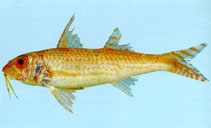
Taxonomic Remarks
FishBase common name changed from Two-tone goatfish to Twotone goatfish (Uiblein et al., 2024: Ref. 130857).
Ambiente: milieu / zona climática / intervalo de profundidade / gama de distribuição
Ecologia
marinhas demersal; intervalo de profundidade 8 - 165 m (Ref. 98481). Tropical
Indo-West Pacific: from S Mozambique and the Red Sea to Japan, N Australia and New Caledonia.
Comprimento na primeira maturidade / Tamanho / Peso / Idade
Maturidade: Lm 11.5, range 11 - 11.9 cm
Max length : 16.0 cm SL macho/indeterminado; (Ref. 83903)
Espinhos dorsais (total) : 7; Raios dorsais moles (total) : 9. This species is distinguished by the following characters: D VII + 9; pectoral fins 12-15; gill rakers 5-8 + 16-19 = 23-26. Measurements as %SL for adults: body depth at first dorsal fin origin 21-26 and at anus 18-22; caudal-peduncle depth 9.3-11; maximum head depth 18-22 and through eye 15-18; head length 26-29; snout length 9.4-12; orbit length 5.9-8.5; upper jaw length 9.5-12; barbel length 16-20; caudal-fin length 27-31; anal-fin height 15-19; pelvic-fin length 19-22; pectoral-fin length 19-22; first dorsal-fin height 20-25, at least one of the first 3 spines disproportionally higher; second dorsal-fin height 14-18; total oblique bars on caudal fin 7-16; upper caudal-fin lobe with 5-6 (rarely 4) reddish bars with 4-5 (rarely 3) bars distally from fork and one bar close to fin lobe base, of similar width or narrower than the pale interspaces between bars; there are 2-10 often faint, rather short and/or irregularly arranged red bars on ventral margin of lower caudal-fin lobe, sometimes extending to dorsal half of lobe or connecting to a red stripe which covers the lobe dorsally to two-thirds of its width at maximum; the caudal-fin lobe bars and stripe fade away after death and only traces retained in preserved fish; when fresh, barbels yellow rarely white; body colour may be variable, often white or rose below lateral line, covered by red pigmentation above lateral line which may also reach down ventrally and to head, sometimes forming red patches or blotches; body raely with a faint red or red-orange mid-lateral stripe from behind eye to caudal-fin base; when preserved, the body is pale brown and not dorsally darkened (Ref. 83903).
Body shape (shape guide): fusiform / normal; Cross section: compressed.
Uiblein, F. and P.C. Heemstra, 2010. A taxonomic review of the Western Indian Ocean goatfishes of the genus Upeneus (Family Mullidae), with descriptions of four new species. Smithiana 11:35-71. (Ref. 83903)
Categoria na Lista Vermelha da IUCN (Ref. 130435: Version 2025-2 (Global))
Ameaça para o homem
Harmless
Utilização humana
Ferramentas
Relatórios especiais
Descarregue XML
Fontes da internet
Estimativas baseadas em modelos
Índice de diversidade filogenética (Ref.
82804): PD
50 = 0.5000 [Uniqueness, from 0.5 = low to 2.0 = high].
Bayesian length-weight: a=0.01122 (0.00653 - 0.01928), b=3.06 (2.91 - 3.21), in cm total length, based on LWR estimates for this species & Genus-body shape (Ref.
93245).
Nível Trófico (Ref.
69278): 3.5 ±0.0 se; based on diet studies.
Resiliência (Ref.
120179): Elevada, tempo mínimo de duplicação da população menor que 15 meses (Fecundity=14,000).
Vulnerabilidade da pesca (Ref.
59153): Low vulnerability (10 of 100).
🛈