>
Perciformes/Scorpaenoidei (Scorpionfishes) >
Sebastidae (Rockfishes, rockcods and thornyheads) > Sebastinae
Etymology: Sebastes: Greek, sebastes = august, venerable (Ref. 45335); proriger: From the Latin prora and gero, meaning 'bow' and 'to bear' (Ref. 27436).
More on authors: Jordan & Gilbert.
Ambiente: milieu / zona climatica / distribuzione batimetrica / gamma di distribuzione
Ecologia
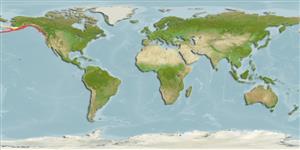
marino batidemersale; distribuzione batimetrica 12 - 425 m (Ref. 6793), usually 183 - 274 m (Ref. 27437). Deep-water; 66°N - 32°N, 177°E - 116°W
North Pacific: Pribilof Canyon in the Bering Sea and Amchitka Island in the Aleutian chain to San Diego, California, USA.
Dimensione / Peso / Età
Maturità: Lm ? range ? - ? cm
Max length : 61.0 cm TL maschio/sesso non determinato; (Ref. 27437); Età massima riportata: 55 anni (Ref. 39247)
Breve descrizione
Chiavi di identificazione | Morfologia | Morfometria
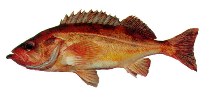
Spine dorsali (totale) : 13; Raggi dorsali molli (totale) : 13 - 15; Spine anali: 3; Raggi anali molli: 6 - 7. Head spines weak - nasal, preocular, postocular, tympanic and parietal spines present, supraocular, coronal and nuchal spines absent (Ref. 27437). Notch on dorsal fin shallow; 2nd anal fin spine is of the same length or shorter than the 3rd (Ref. 27437). Caudal fin moderately indented (Ref. 6885). Light red and mottled with olive on back, lower sides flushed with yellow; light red stripe along lateral line; lips blackened; fins red with some light green or yellow (Ref. 27437).
Body shape (shape guide): fusiform / normal.
Occur in areas where rocky reefs and steep silt-covered cliff faces meet gently sloping sand or mud bottoms (Ref. 27436). Found hovering just off the bottom or resting on a rocky perch (Ref. 27436). Viviparous (Ref. 34817). Sold as fresh or frozen fillets, together with other rockfish species (Ref. 27436). Not popular as a game fish (Ref. 27436).
Ciclo vitale e comportamento di accoppiamento
Maturità | Riproduzione | Deposizione | Uova | Fecondità | Larve
Eschmeyer, W.N., E.S. Herald and H. Hammann, 1983. A field guide to Pacific coast fishes of North America. Boston (MA, USA): Houghton Mifflin Company. xii+336 p. (Ref. 2850)
Stato della Lista Rossa IUCN (Ref. 130435: Version 2025-2 (Global))
Minaccia per l'uomo
Harmless
Usi umani
Pesca: commerciale; Pesce da pesca sportiva: si
Strumenti
Rapporti speciali
Scarica XML
Fonti Internet
Stime basate su modelli
Temperatura preferita (Fonte Biblio.
123201): 3.7 - 6.6, mean 5.4 °C (based on 51 cells).
Indice di diversità filogenetica (Fonte Biblio.
82804): PD
50 = 0.5000 [Uniqueness, from 0.5 = low to 2.0 = high].
Bayesian length-weight: a=0.01000 (0.00490 - 0.02040), b=3.09 (2.92 - 3.26), in cm total length, based on LWR estimates for this Genus-body shape (Ref.
93245).
Livello trofico (Fonte Biblio.
69278): 3.8 ±0.5 se; based on size and trophs of closest relatives
Generation time: 7.4 ( na - na) years. Estimated as median ln(3)/K based on 2
growth studies.
Resilienza (Fonte Biblio.
120179): Basso, tempo minimo di raddoppiamento della popolazione 4.5 - 14 anni (K=0.15-0.18; tmax=55).
Vulnerabilità della pesca (Ref.
59153): High vulnerability (58 of 100).
🛈