Klassifizierung / Names
Namen | Synonyme | Catalog of Fishes(Gattung, Arten) | ITIS | CoL | WoRMS | Cloffa
>
Eupercaria/misc (Various families in series Eupercaria) >
Labridae (Wrasses) > Hypsigenyinae
Etymology: Bodianus: Bodianus after Bodiano or Pudiano, from the Portuguese pudor, meaning modesty (Jordan & Evermann, 1896).
More on authors: Bloch & Schneider.
Umwelt: Milieu / Klimazone / Tiefenbereich / Verbreitungsgebiet
Ökologie
seewasser riff-verbunden; tiefenbereich 8 - 100 m (Ref. 89896), usually ? - 40 m (Ref. 9626). Tropical; 34°N - 8°N, 98°W - 60°W
Western Atlantic: Bermuda, southern Florida (USA), and Bahamas to northern South America.
Größe / Gewicht / Alter
Geschlechtsreife: Lm ? range ? - ? cm
Max length : 30.0 cm TL Männchen/unbestimmt; (Ref. 7251); common length : 22.0 cm TL Männchen/unbestimmt; (Ref. 5217); max. veröff. Gewicht: 320.00 g (Ref. 9626)
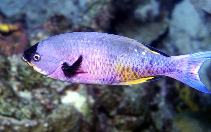
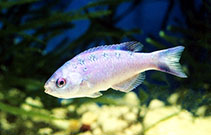
Rückenflossenstacheln (insgesamt) : 12; Rückenflossenweichstrahlen (insgesamt) : 10; Afterflossenstacheln: 3; Afterflossenweichstrahlen: 12 - 13. Moderately elongate, compressed fish with equally curved upper and lower profiles (Ref. 26938). Color primarily violet or purple; large individuals with a wash of yellow on lower two-thirds of body; prolonged portions of dorsal and anal fins and tips of pelvic fins blackish (Ref. 13442). Caudal fin emarginate in young, lunate in adults (Ref 52831).
Body shape (shape guide): fusiform / normal.
Inhabits seaward reef slopes; occasionally on shallow patch reefs (Ref. 9710). Found in large midwater aggregations feeding on plankton (Ref. 9710), small jellyfishes, pteropods, pelagic tunicates and various invertebrate larvae (Ref. 13442). Form leks during breeding (Ref. 55367). Also caught with beach nets (Ref. 5217).
Lebenszyklus und Paarungsverhalten
Geschlechtsreife | Fortpflanzung | Ablaichen | Eier | Fruchtbarkeit | Larven
Forms lek during breeding (Ref. 55367). A monandric species (Ref. 55367). Length at sex change = 15.78 cm TL (Ref. 55367).
Cervigón, F., 1993. Los peces marinos de Venezuela. Volume 2. Fundación Científica Los Roques, Caracas,Venezuela. 497 p. (Ref. 9626)
IUCN Rote Liste Status (Ref. 130435: Version 2025-2 (Global))
Bedrohung für Menschen
Harmless
Nutzung durch Menschen
Fischereien: weniger kommerziell; Aquarium: Kommerziell
Tools
Zusatzinformationen
Download XML
Internet Quellen
Schätzungen auf der Grundlage von Modellen
Bevorzugte Temperatur (Ref.
123201): 24.3 - 28, mean 26.8 °C (based on 170 cells).
Phylogenetischer Diversitätsindex (Ref.
82804): PD
50 = 0.5000 [Uniqueness, from 0.5 = low to 2.0 = high].
Bayesian length-weight: a=0.01047 (0.00493 - 0.02225), b=3.08 (2.90 - 3.26), in cm total length, based on LWR estimates for this Genus-body shape (Ref.
93245).
Trophische Ebene (Ref.
69278): 3.4 ±0.2 se; based on diet studies.
Widerstandsfähigkeit (Ref.
120179): mittel, Verdopplung der Population dauert 1,4 - 4,4 Jahre. (Preliminary K or Fecundity.).
Anfälligkeit der Fischerei (Ref.
59153): Low vulnerability (20 of 100).
🛈
Nährstoffe (Ref.
124155): Calcium = 52.4 [30.9, 87.4] mg/100g; Iron = 0.678 [0.394, 1.255] mg/100g; Protein = 18.3 [15.4, 20.5] %; Omega3 = 0.151 [0.095, 0.237] g/100g; Selenium = 33.1 [19.0, 60.3] μg/100g; VitaminA = 167 [55, 573] μg/100g; Zinc = 1.32 [0.92, 2.03] mg/100g (wet weight);