>
Salmoniformes (Salmons) >
Salmonidae (Salmonids) > Coregoninae
Etymology: Coregonus: Greek, kore = pupils of the eye + Greek, gonia = angle (Ref. 45335); clupeaformis: clupeaformis meaning herring-shaped (Ref. 1998).
More on author: Mitchill.
Ambiente: milieu / zona climática / intervalo de profundidade / gama de distribuição
Ecologia
; Água doce; estuarina bentopelágico; anádromo (Ref. 120291); intervalo de profundidade 8 - 128 m (Ref. 3849). Temperate; 8°C - 14°C (Ref. 1998); 72°N - 41°N, 149°W - 61°W (Ref. 86798)
North America: Atlantic, Arctic and Pacific basins throughout most of Canada south into New England, the Great Lakes basin, and central Minnesota, USA; Copper and Susitna river drainages in Alaska. Introduced in northwestern USA (Ref. 86798). This species was stocked into high Andean lakes in two countries in southern Latin America (Ref. 1739). Probably conspecific with Coregonus lavaretus (Ref. 7506). Belongs to Coregonus clupeaformis complex (Ref. 27547).
Comprimento na primeira maturidade / Tamanho / Peso / Idade
Maturidade: Lm ? range ? - ? cm
Max length : 100.0 cm TL macho/indeterminado; (Ref. 9988); common length : 54.1 cm TL macho/indeterminado; (Ref. 12193); peso máx. Publicado: 19.0 kg (Ref. 28850); Idade máx. registada: 50 anos (Ref. 3494)
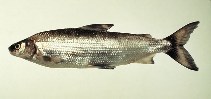
Espinhos dorsais (total) : 0; Raios dorsais moles (total) : 11 - 13; Espinhos anais: 0; Raios anais moles: 10 - 14; Vértebras: 55 - 64. Adipose fin well developed, often larger in males; axillary process present in pelvic fins (Ref. 27547). Dark brown to midnight blue above fading to silver on sides and wide beneath; no parr marks in young (Ref. 27547).
Body shape (shape guide): fusiform / normal; Cross section: oval.
Inhabits large lakes and large rivers and enters brackish water (Ref. 86798). Primarily a lake dweller (Ref. 27547). Nerito-pelagic (Ref. 58426). Appears to be rather sedentary, at least in the Great Lakes (Ref. 27547). Movement in large lakes generally consists of 4 stages: movement from deep to shallow water in the spring; movement back to deep water in the summer as the shoal water warms; migration to shallow-water spawning areas in the fall and early winter; and post-spawning movement back to deeper water (Ref. 27547). Forms separate populations in large lakes (Ref. 27547). Adults feed mainly on aquatic insect larvae, mollusks and amphipods (Ref. 1091, 3849); also other fishes and fish eggs, including their own (Ref. 1998). Extensive hatchery programs for the propagation have been carried out on the Great Lakes and other areas for years (Ref. 3746, 3849). Valued for its meat as well as for its roe, which is made into an excellent caviar; utilized fresh, smoked, and frozen; eaten steamed, fried, broiled, boiled, microwaved, and baked (Ref. 9988).
Spawning occurs at night (Ref. 10242, 10344, 28849). A female and one or more males rise to the surface, release eggs and milt and descend separately toward the bottom (Ref. 27547). Spawning fish are very active and may leap completely out of the water (Ref. 1998). Breeds annually in the southern parts of the range, but only every other year or even every third year in the arctic and sub-arctic regions (Ref. 3757).
Page, L.M. and B.M. Burr, 2011. A field guide to freshwater fishes of North America north of Mexico. Boston : Houghton Mifflin Harcourt, 663p. (Ref. 86798)
Categoria na Lista Vermelha da IUCN (Ref. 130435: Version 2025-2 (Global))
Ameaça para o homem
Harmless
Utilização humana
Pescarias: espécies comerciais; peixe desportivo: sim; Aquário: Aquários públicos
Ferramentas
Relatórios especiais
Descarregue XML
Fontes da internet
Estimativas baseadas em modelos
Índice de diversidade filogenética (Ref.
82804): PD
50 = 0.5000 [Uniqueness, from 0.5 = low to 2.0 = high].
Bayesian length-weight: a=0.00550 (0.00475 - 0.00636), b=3.23 (3.19 - 3.27), in cm total length, based on LWR estimates for this species (Ref.
93245).
Nível Trófico (Ref.
69278): 3.2 ±0.2 se; based on diet studies.
Generation time: 4.4 (3.9 - 5.5) years. Estimated as median ln(3)/K based on 59
growth studies.
Resiliência (Ref.
120179): Baixo, tempo mínimo de duplicação da população 4,5 - 14 anos (K=0.06-0.19; tmax=50).
Vulnerabilidade da pesca (Ref.
59153): Moderate to high vulnerability (51 of 100).
🛈
Nutrientes (Ref.
124155): Calcium = 11.6 [7.5, 20.7] mg/100g; Iron = 0.279 [0.200, 0.389] mg/100g; Protein = 17.7 [16.5, 18.8] %; Omega3 = 0.96 [0.41, 2.48] g/100g; Selenium = 20.8 [10.7, 46.0] μg/100g; VitaminA = 12.2 [4.7, 31.8] μg/100g; Zinc = 0.538 [0.439, 0.650] mg/100g (wet weight); based on
nutrient studies.