>
Ovalentaria/misc (Various families in series Ovalentaria) >
Plesiopidae (Roundheads) > Acanthoclininae
Etymology: Acanthoclinus: Greek, akantha = thorn + Greek, klinein, kline = sloping and bed, due to the four apophyses of sphenoid bone (Ref. 45335).
More on author: Jenyns.
Ambiente: milieu / zona climática / intervalo de profundidade / gama de distribuição
Ecologia
marinhas; estuarina demersal; não migratória; intervalo de profundidade 0 - 4 m (Ref. 9003). Temperate; 34°S - 44°S, 172°E - 176°E (Ref. 56302)
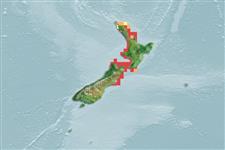
Southwest Pacific: endemic to New Zealand.
Tamanho / Peso / Idade
Maturidade: Lm ? range ? - ? cm
Max length : 30.0 cm TL macho/indeterminado; (Ref. 9003); Idade máx. registada: 9 anos (Ref. 9003)
Descrição breve
Chaves de identificação | Morfologia | Morfometria
Espinhos dorsais (total) : 20; Raios dorsais moles (total) : 4; Espinhos anais: 9; Raios anais moles: 4.
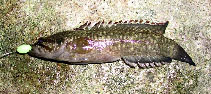
Body shape (shape guide): elongated.
Facultative air-breathing (Ref. 126274); Are residents of intertidal zone with homing behavior (Ref. 32612) found in pools with rocks or boulders. May leave tide pools if aquatic conditions become inhospitable (Ref. 31184). Feed mostly on invertebrates, particularly crustaceans and mollusks. They breathe air when out of water (Ref. 31184) and swim with an eel-like motion (Ref. 9003). Eggs are guarded by the male parent (Ref. 205).
Ciclo de vida e comportamento de acasalamento
Maturidade | Reprodução | Desova | Ovos | Fecundidade | Larvas
Nests are constructed beneath boulders where the dense gelatinous cluster of about 10,000 eggs are deposited. The male stands guard and seals the nest from the inside by blocking the entrance with small stones and mud. Eggs hatch after about ten days into planktonic larvae (Ref. 9003).
Paulin, C. and C. Roberts, 1992. The rockpool fishes of New Zealand (Te ika aaria o Aotearoa). Museum of New Zealand (Te Papa Tongarewa). 177 p. (Ref. 9003)
Categoria na Lista Vermelha da IUCN (Ref. 130435: Version 2025-2 (Global))
Ameaça para o homem
Harmless
Utilização humana
Pescarias: sem interesse
Ferramentas
Relatórios especiais
Descarregue XML
Fontes da internet
Estimativas baseadas em modelos
Temperatura preferida (Ref.
123201): 12.3 - 18.4, mean 16.3 °C (based on 64 cells).
Índice de diversidade filogenética (Ref.
82804): PD
50 = 0.5312 [Uniqueness, from 0.5 = low to 2.0 = high].
Bayesian length-weight: a=0.00468 (0.00181 - 0.01207), b=3.11 (2.88 - 3.34), in cm total length, based on LWR estimates for this (Sub)family-body shape (Ref.
93245).
Nível Trófico (Ref.
69278): 3.6 ±0.59 se; based on food items.
Resiliência (Ref.
120179): Médio, tempo mínimo de duplicação da população 1,4 - 4,4 anos (tmax=9).
Vulnerabilidade da pesca (Ref.
59153): Low vulnerability (20 of 100).
🛈