>
Eupercaria/misc (Various families in series Eupercaria) >
Labridae (Wrasses) > Scarinae
Etymology: Scarus: Greek, skaros = a fish described by anciente writers as a parrot fish; 1601 (Ref. 45335).
Eponymy: Paul Erdmann Isert (1756–1789) was a German botanist, also known for his opposition to the Danish-Norwegian slave trade. [...] (Ref. 128868), visit book page.
More on author: Bloch.
Ambiente: milieu / zona climática / intervalo de profundidade / gama de distribuição
Ecologia
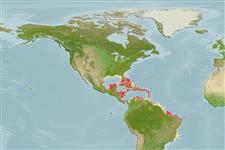
marinhas associadas(os) a recifes; intervalo de profundidade 3 - 25 m (Ref. 9710). Subtropical; 23°C - 26°C (Ref. 130582); 33°N - 26°S, 98°W - 31°W
Western Atlantic: Bermuda, Florida (USA), Bahamas, and northeastern Gulf of Mexico to northern South America; throughout the Caribbean (Ref. 3802, 13628). Range probably extends to Brazil (Ref. 13628).
Comprimento na primeira maturidade / Tamanho / Peso / Idade
Maturidade: Lm ?, range 16 - ? cm
Max length : 35.0 cm TL macho/indeterminado; (Ref. 9710); common length : 18.0 cm TL macho/indeterminado; (Ref. 3802)
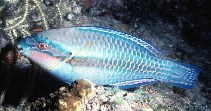
Espinhos dorsais (total) : 9; Raios dorsais moles (total) : 10; Espinhos anais: 3; Raios anais moles: 9. White stripe above upper dark stripe ends at gill opening; upper and lower caudal margins pale (Ref. 26938). Terminal phase males are blue-green and orange, chest and head pink below a green band at lower edge of eye; median fins with blue borders, the broad central parts orange with linear blue markings (Ref. 13442).
Body shape (shape guide): fusiform / normal.
Found over shallow, clear waters, generally over Thalassia beds (Ref. 13628). Also found rocky or coral areas (Ref. 13628). A schooling species. Feeds on plants. A protogynous hermaphrodite (Ref. 55367). Super males spawn individually with striped females, while sexually mature males in the striped phase spawn in aggregation.
Ciclo de vida e comportamento de acasalamento
Maturidade | Reprodução | Desova | Ovos | Fecundidade | Larvas
Diandric. Length at sex change = 9.6 cm TL (Ref. 55367). Forms harem groups composed of a single male and several smaller females (Ref. 55367).
Böhlke, J.E. and C.C.G. Chaplin, 1993. Fishes of the Bahamas and adjacent tropical waters. 2nd edition. University of Texas Press, Austin. (Ref. 5521)
Categoria na Lista Vermelha da IUCN (Ref. 130435: Version 2025-2 (Global))
Ameaça para o homem
Reports of ciguatera poisoning (Ref. 30911)
Utilização humana
Pescarias: pouco comercial; Aquário: Espécies comerciais
Ferramentas
Relatórios especiais
Descarregue XML
Fontes da internet
Estimativas baseadas em modelos
Temperatura preferida (Ref.
123201): 26.3 - 28.2, mean 27.4 °C (based on 645 cells).
Índice de diversidade filogenética (Ref.
82804): PD
50 = 0.5000 [Uniqueness, from 0.5 = low to 2.0 = high].
Bayesian length-weight: a=0.01072 (0.00690 - 0.01664), b=3.02 (2.89 - 3.15), in cm total length, based on LWR estimates for this species & Genus-body shape (Ref.
93245).
Nível Trófico (Ref.
69278): 2.0 ±0.0 se; based on diet studies.
Resiliência (Ref.
120179): Elevada, tempo mínimo de duplicação da população menor que 15 meses (Preliminary K or Fecundity).
Vulnerabilidade da pesca (Ref.
59153): Low vulnerability (25 of 100).
🛈
Nutrientes (Ref.
124155): Calcium = 36.8 [20.5, 68.6] mg/100g; Iron = 0.994 [0.617, 1.743] mg/100g; Protein = 19.4 [17.3, 21.2] %; Omega3 = 0.135 [0.077, 0.254] g/100g; Selenium = 10.9 [5.3, 21.4] μg/100g; VitaminA = 18.9 [4.6, 78.1] μg/100g; Zinc = 1.74 [1.18, 2.59] mg/100g (wet weight);