Ikan bertulang rawan (sharks and rays) >
Carcharhiniformes (Ground sharks) >
Sphyrnidae (Hammerhead, bonnethead, or scoophead sharks)
Etymology: Sphyrna: Probable misspelling of sphyra (Gr.), hammer, referring to their hammer-shaped heads (See ETYFish); lewini: Patronym not identified, perhaps in honor of John Lewin (1770-1819), who illustrated early volumes of Australian natural history (this shark was described from Australia) and may be the “Mr. Lewin” who illustrated the plates in Griffith and Smith’s book (See ETYFish).
Eponymy: John William Lewin (1770–1819) was an English naturalist and engraver. [...] (Ref. 128868), visit book page.
Lingkungan: lingkungan / zona iklim / kisaran kedalaman / jangkauan distribusi
Ekologi
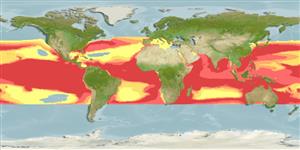
laut; payau pelagic-oceanic; oceanodromus (Ref. 87829); kisaran kedalaman 0 - 1043 m (Ref. 89972), usually 0 - 25 m (Ref. 26999). Tropical; 46°N - 39°S, 180°W - 180°E
Circumglobal in coastal warm temperate and tropical seas (Ref. 13562). Western Atlantic: New Jersey, USA to Uruguay (Ref. 58839), including the Gulf of Mexico and Caribbean. Eastern Atlantic: western Mediterranean (Ref. 6678) to Namibia (Ref. 6812). Indo-Pacific: Persian Gulf (Ref. 68964), Red Sea, East Africa and throughout the Indian Ocean; Japan to New Caledonia, Hawaii and Tahiti. Eastern Pacific: southern California, USA to Ecuador, probably Peru.
Panjang pada saat jatuh tempo pertama / Ukuran / Berat / umur
Kematangan: Lm 210.5, range 140 - 273 cm
Max length : 430 cm TL jantan/; (Ref. 26938); common length : 360 cm TL jantan/; (Ref. 13562); Berat maksimum terpublikasi: 152.4 kg (Ref. 40637); Umur maksimum dilaporkan: 35 Tahun (Ref. 31395)
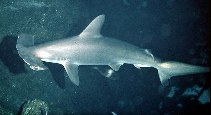
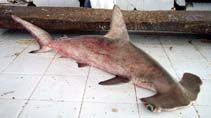
Duri punggung (Keseluruhan (total)) : 0; Duri dubur: 0. This hammerhead shark is distinguished by having the following characters: large, moderately slender body; broad, narrow bladed head, arched anterior margin with prominent median indentation and lateral indentation; nostrils with strong prenarial grooves; hind margins of eyes slightly posterior to or nearly opposite front of mouth; teeth triangular, deeply notched posteriorly, with smooth or finely serrated edges; first dorsal fin moderately high, second dorsal and pectoral fins low; upper precaudal pit transverse crescentric. Colour of body light grey or greyish brown above, shading to white below, pectoral fin tips dusky and a dark blotch on lower caudal fin lobe (Ref. 13562, 114967).
Body shape (shape guide): elongated.
A coastal-pelagic, semi-oceanic shark occurring over continental and insular shelves and adjacent deep water, often approaching close inshore and entering enclosed bays and estuaries (Ref. 244, 11230, 58302). Found in inshore and offshore waters to about 275 m depth (Ref. 26938, 11230, 58302); has been filmed at a baited camera in 512 m depth (Lis Maclaren, pers. comm. 2005). Huge schools of small migrating individuals move pole ward in the summer in certain areas (Ref. 244). Permanent resident populations also exist (Ref. 244). Juveniles occur in coastal areas (Ref. 58784). Adults solitary, in pairs, or schools; young in large schools (Ref. 13562). Feed mainly on teleost fishes and cephalopods (Ref. 6871), also lobsters, shrimps, crabs (Ref. 30573), including other sharks and rays (Ref. 37816). Viviparous (Ref. 50449). Mature females produce 15-31, of 43-55 cm young in a litter (Ref. 26938, 1602). Considered potentially dangerous to people but often not aggressive when approached by divers (Ref. 13562). Readily available to inshore artisanal and small commercial fisheries as well as to offshore operations (Ref. 13562). Sold fresh, dried-salted, smoked and frozen; also sought for its fins and hides (Ref. 9987). Oil used for vitamins and carcasses for fishmeal (Ref. 13562). Maximum depth from Ref. 125614.
Viviparous, placental (Ref. 50449), with 13-23 in a litter (Ref. 6871); 12-41 pups after a gestation period of 9-10 months (Ref.58048). Size at birth 45-50 cm TL (Ref. 13562); 39-57 cm TL (Ref.58048).
Compagno, L.J.V., 1984. FAO Species Catalogue. Vol. 4. Sharks of the world. An annotated and illustrated catalogue of shark species known to date. Part 2 - Carcharhiniformes. FAO Fish. Synop. 125(4/2):251-655. Rome: FAO. (Ref. 244)
Status IUCN Red List (Ref. 130435: Version 2025-2 (Global))
penggunaan manusia
Perikanan: komersial; Ikan buruan: ya
Alat, peralatan
laporan khas
muat turun XML
Sumber internet
Estimasi berdasarkan model
Suhu yang disukai (Acuan
123201): 18.7 - 29, mean 27.2 °C (based on 2890 cells).
Indeks keanekaragaman filogenetik (Acuan
82804): PD
50 = 0.5006 [Uniqueness, from 0.5 = low to 2.0 = high].
Bayesian length-weight: a=0.00347 (0.00276 - 0.00435), b=3.10 (3.03 - 3.17), in cm total length, based on LWR estimates for this species (Ref.
93245).
Tingkat Trofik (Acuan
69278): 4.1 ±0.5 se; based on diet studies.
Generation time: 13.7 (11.0 - 15.5) years. Estimated as median ln(3)/K based on 15
growth studies.
Daya lenting (Acuan
120179): Rendah, Waktu penggandaan populasi minimum 4.5 - 14 tahun (rm=0.028; K=0.05-0.24; tm=3-15; tmax=41.6; Fec=13-23).
Prior r = 0.06, 95% CL = 0.04 - 0.09, Based on 2 data-limited stock assessments.
Kerentanan Penangkapan Ikan (Ref.
59153): Very high vulnerability (78 of 100).
🛈
Kerentanan Iklim (Ref.
125649): High vulnerability (62 of 100).
🛈
Nutrisi (Ref.
124155): Calcium = 11.1 [2.3, 63.0] mg/100g; Iron = 0.63 [0.15, 2.02] mg/100g; Protein = 19.7 [17.6, 22.0] %; Omega3 = 0.129 [0.051, 0.334] g/100g; Selenium = 84.6 [24.3, 265.5] μg/100g; VitaminA = 9.24 [3.00, 30.53] μg/100g; Zinc = 0.642 [0.304, 1.209] mg/100g (wet weight);