Ambiente: milieu / zona climatica / distribuzione batimetrica / gamma di distribuzione
Ecologia
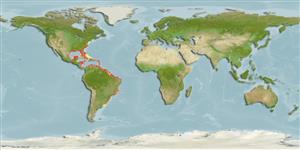
marino associati a barriera corallina; distribuzione batimetrica 1 - 50 m (Ref. 93252), usually 5 - ? m (Ref. 9710). Tropical; 41°N - 37°S, 98°W - 33°W (Ref. 188)
Western Atlantic: Gulf of Maine (USA), Bermuda, throughout the Gulf of Mexico, Caribbean and West Indies southward to Santa Catarina, Brazil. Also found in Uruguay (Ref. 54736) and Argentina (Ref. 2806).
Lunghezza alla prima maturità / Dimensione / Peso / Età
Maturità: Lm 11.5, range 11 - ? cm
Max length : 38.0 cm TL maschio/sesso non determinato; (Ref. 5217); common length : 20.0 cm SL maschio/sesso non determinato; (Ref. 188); peso massimo pubblicato: 375.00 g (Ref. 5217)
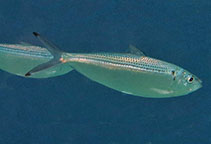
Spine dorsali (totale) : 0; Raggi dorsali molli (totale) : 19 - 21; Spine anali: 0; Raggi anali molli: 23 - 24. The filamentous last dorsal fin ray distinguishes this species from all other western Atlantic clupeoids except Dorosoma, which has an inferior mouth (Ref. 188). Otherwise, superficially resembles species of Sardinella (but i 8 pelvic fin rays in western Atlantic species, cf. i 7 in Opisthonema) and Harengula (but small toothed hypomaxilla in upper jaw) (Ref. 188). Lower gill rakers stable at 28 to 46 after 8 cm (Ref. 188). Silvery, with a bluish or greenish back, 6-7 lengthwise dark streaks on side. Dark spot above opercle, larger dark spot behind opercle, usually with a row of dark spots behind it. Lower profile deeply curved. Head pointed (Ref. 7251).
Body shape (shape guide): fusiform / normal; Cross section: compressed.
Inhabit harbors and shallow coastal areas (Ref. 9710). Pelagic (Ref. 27549). Form schools (but solitary individuals reported), probably not entering water of low salinity. Feed by filtering plankton (copepods), but also take small fishes, crabs and shrimps. Marketed fresh, frozen and salted; also used in the fishmeal industry. Occur in freshwater in St. Johns River, Florida (Ref. 26938).
Ciclo vitale e comportamento di accoppiamento
Maturità | Riproduzione | Deposizione | Uova | Fecondità | Larve
Possibly breeds in March-July off Venezuela.
Whitehead, P.J.P., 1985. FAO Species Catalogue. Vol. 7. Clupeoid fishes of the world (suborder Clupeoidei). An annotated and illustrated catalogue of the herrings, sardines, pilchards, sprats, shads, anchovies and wolf-herrings. FAO Fish. Synop. 125(7/1):1-303. Rome: FAO. (Ref. 188)
Stato della Lista Rossa IUCN (Ref. 130435: Version 2025-2 (Global))
Minaccia per l'uomo
Reports of ciguatera poisoning (Ref. 30911)
Usi umani
Pesca: commerciale; esca: usually
Strumenti
Rapporti speciali
Scarica XML
Fonti Internet
Stime basate su modelli
Temperatura preferita (Fonte Biblio.
123201): 22.7 - 28, mean 25.5 °C (based on 480 cells).
Indice di diversità filogenetica (Fonte Biblio.
82804): PD
50 = 0.5312 [Uniqueness, from 0.5 = low to 2.0 = high].
Bayesian length-weight: a=0.00851 (0.00758 - 0.00956), b=3.06 (3.03 - 3.09), in cm total length, based on LWR estimates for this species (Ref.
93245).
Livello trofico (Fonte Biblio.
69278): 4.5 ±0.0 se; based on diet studies.
Resilienza (Fonte Biblio.
120179): Medio, tempo minimo di raddoppiamento della popolazione 1.4 - 4.4 anni (tm=1-3; tmax=8).
Prior r = 1.18, 95% CL = 0.78 - 1.77, Based on 4 data-limited stock assessments.
Vulnerabilità della pesca (Ref.
59153): Low vulnerability (24 of 100).
🛈
Vulnerabilità climatica (Ref.
125649): Moderate to high vulnerability (54 of 100).
🛈
Nutrienti (Ref.
124155): Calcium = 59.1 [28.2, 107.6] mg/100g; Iron = 0.805 [0.394, 1.446] mg/100g; Protein = 19.9 [18.5, 21.2] %; Omega3 = 0.242 [0.132, 0.455] g/100g; Selenium = 34.8 [18.7, 79.4] μg/100g; VitaminA = 95.7 [28.7, 303.9] μg/100g; Zinc = 0.856 [0.565, 1.280] mg/100g (wet weight);