वर्गीकरण / नाम
आम नाम | उपशब्द | Catalog of Fishes(वर्ग, प्रजाति) | ITIS | CoL | WoRMS | Cloffa
पर्यावरण: पर्यावरण / जलवायु क्षेत्र / गहराई सीमा / वितरण सीमा
पारिस्थितिकी
; स्वच्छ जल, अलवण जल; खारा बेनथोपिलाजिक; pH range: 7.0 - 7.5; dH range: 10 - 15; पोटामोड़िरोमस (Ref. 126106); गहराई सीमा 15 - ? m (Ref. 5732). Temperate; 4°C - 20°C (Ref. 1672); 73°N - 37°N, 7°E - 136°E
Europe and Asia: Baltic, Black, northern Caspian and North Sea basins, Atlantic basin southward to Seine and lower Loire drainages (France). Absent in Scandinavia north of 69°N. In Asia, eastward to Lena drainage and Aral basin. Introduced to Great Britain and northern Italy (Ref. 59043). Transported to several countries in Europe and the United States for ornament (Ref. 4537).
प्रथम परिपक्वता पर लंबाई / आकार / वज़न / आयु
परिपक्व अवधि: Lm ? range ? - ? cm
Max length : 85.0 cm SL पुल्लिंग / अलिंग; (Ref. 59043); common length : 30.0 cm TL पुल्लिंग / अलिंग; (Ref. 556); अधिकतम प्रकाशित वज़न: 4.0 kg (Ref. 556); अधिकतम सूचित उम्र: 29 वर्षो (Ref. 126842)
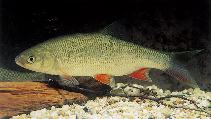
पृष्ठीय रीढ़ (सम्पूर्ण) : 3; पृष्ठीय सौफट रेज़ (सम्पूर्ण) : 8 - 11; गुदा कांटा: 3; ऐनल सौफट रेज़: 8 - 11; जानवरों की रीड़ का जोड़: 47. Diagnosed from congeners in Europe by the following characters: lateral line with 56-58 + 3 scales; pharyngeal teeth 3,5-5,3; mouth terminal; dorsal fin with 8½ branched rays; anal fin with 10-11½ branched rays; all fins except dorsal fin with reddish tinge; pigmentation on lateral scales lacking regular black mesh (Ref. 59043). Caudal fin with 19 rays (Ref. 2196).
Body shape (shape guide): fusiform / normal.
Adults are usually found in large lowland rivers and nutrient-rich lakes. Adults are solitary while juveniles are gregarious. They undertake migration to tributaries to spawn in moderate current on gravel or submerged vegetation. Food consists of various aquatic and terrestrial animals and plant material. Larger individuals feed mainly on fishes. Feeding larvae and juveniles thrive in a wide variety of shoreline habitats and leave the shores for deeper waters when growing. Reported to sometimes hybridizes with Aspius aspius (Ref. 59043). Flesh is not tasty (Ref. 30578). Aquarium keeping: at least 10 individuals; minimum aquarium size >200 cm; not recommended for home aquariums (Ref. 51539).
"Females spawn only once each season. Individual females spawn with several males. Males assemble at spawning grounds and follow ripe females. Females attach the sticky eggs to gravel or submerged plant material" (Ref. 59043).
Kottelat, M. and J. Freyhof, 2007. Handbook of European freshwater fishes. Publications Kottelat, Cornol and Freyhof, Berlin. 646 pp. (Ref. 59043)
आईयूसीएन रेड लिस्ट स्थिति (Ref. 130435: Version 2025-2 (Global))
मनुष्यों के लिए ख़तरा
Harmless
मानव उपयोग
मात्स्यिकी: व्यापारिक; आखेट मत्स्य: हां; जलजीवालय: व्यापारिक
साधन
विशेष रिपोर्ट
XML डाउनलोड करें
इंटरनेट स्रोत
मॉडल पर आधारित अनुमान
जातिवृति विविधता सूचकांक (संदर्भ
82804): PD
50 = 0.5000 [Uniqueness, from 0.5 = low to 2.0 = high].
Bayesian length-weight: a=0.00589 (0.00481 - 0.00721), b=3.15 (3.12 - 3.18), in cm total length, based on LWR estimates for this species (Ref.
93245).
ट्रॉफिक स्तर (संदर्भ
69278): 3.8 ±0.59 se; based on food items.
लौटाव (संदर्भ
120179): निम्न, न्यूनतम जनसंख्या दुगनी होने का समय 4.5 - 14 वर्ष। (tm=5-9).
मछली पकड़ने की भेद्यता (Ref.
59153): High to very high vulnerability (69 of 100).
🛈
पोषक तत्व (Ref.
124155): Calcium = 63.1 [29.0, 124.9] mg/100g; Iron = 0.636 [0.374, 1.054] mg/100g; Protein = 19.5 [17.9, 21.2] %; Omega3 = 0.66 [0.33, 1.31] g/100g; Selenium = 11.7 [6.0, 22.7] μg/100g; VitaminA = 23.2 [7.9, 69.8] μg/100g; Zinc = 0.683 [0.480, 0.980] mg/100g (wet weight); based on
nutrient studies.