>
Carangiformes (Jacks) >
Carangidae (Jacks and pompanos) > Caranginae
Etymology: Decapterus: Greek, deka = ten + Greek, pteron = wing, fin (Ref. 45335).
More on author: Bleeker.
Umwelt: Milieu / Klimazone / Tiefenbereich / Verbreitungsgebiet
Ökologie
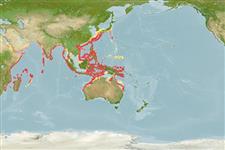
seewasser riff-verbunden; tiefenbereich 100 - 300 m (Ref. 3197), usually 150 - 300 m (Ref. 3197). Deep-water; 38°N - 26°S, 34°E - 148°E
Indo-West Pacific: East Africa to the Philippines, north to southern Japan, south to Western Australia.
Länge bei der ersten Reifung / Größe / Gewicht / Alter
Geschlechtsreife: Lm 17.2 range ? - ? cm
Max length : 45.0 cm TL Männchen/unbestimmt; (Ref. 3197); common length : 30.0 cm FL Männchen/unbestimmt; (Ref. 3287)
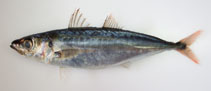
Rückenflossenstacheln (insgesamt) : 9; Rückenflossenweichstrahlen (insgesamt) : 28 - 29; Afterflossenstacheln: 3; Afterflossenweichstrahlen: 22 - 25. Deep bodied compared to similar species (Ref. 48635). Body color bluish green above, silvery below; caudal fin bright red. Sometimes a yellow mid-lateral stripe (Ref. 48635). Opercle with a small black spot; margin of opercular membrane smooth. 31-38 scutes.
Body shape (shape guide): fusiform / normal; Cross section: compressed.
Adults are found in deep waters. They feed on small planktonic invertebrates (Ref. 5213). Occasionally seen in small groups along reef slopes at moderate depths. Mainly known from trawls and shows red tail after capture (Ref. 48635).
Paxton, J.R., D.F. Hoese, G.R. Allen and J.E. Hanley, 1989. Pisces. Petromyzontidae to Carangidae. Zoological Catalogue of Australia, Vol. 7. Australian Government Publishing Service, Canberra, 665 p. (Ref. 7300)
IUCN Rote Liste Status (Ref. 130435: Version 2025-2 (Global))
Bedrohung für Menschen
Harmless
Nutzung durch Menschen
Fischereien: kommerziell
Tools
Zusatzinformationen
Download XML
Internet Quellen
Schätzungen auf der Grundlage von Modellen
Bevorzugte Temperatur (Ref.
123201): 11.5 - 22.4, mean 15 °C (based on 274 cells).
Phylogenetischer Diversitätsindex (Ref.
82804): PD
50 = 0.5005 [Uniqueness, from 0.5 = low to 2.0 = high].
Bayesian length-weight: a=0.01318 (0.00893 - 0.01947), b=3.00 (2.88 - 3.12), in cm total length, based on LWR estimates for this species & Genus-body shape (Ref.
93245).
Trophische Ebene (Ref.
69278): 3.4 ±0.45 se; based on food items.
Widerstandsfähigkeit (Ref.
120179): hoch, Verdopplung der Population dauert weniger als 15 Monate. (K=0.63-1.1; Fec = 6,416).
Anfälligkeit der Fischerei (Ref.
59153): Low vulnerability (25 of 100).
🛈
Nährstoffe (Ref.
124155): Calcium = 58.6 [15.2, 161.2] mg/100g; Iron = 1.09 [0.40, 2.96] mg/100g; Protein = 20.1 [18.6, 21.6] %; Omega3 = 0.31 [0.14, 0.71] g/100g; Selenium = 17.3 [5.0, 56.2] μg/100g; VitaminA = 20.4 [3.5, 129.2] μg/100g; Zinc = 0.478 [0.264, 0.847] mg/100g (wet weight);