| Family: |
Labridae (Wrasses), subfamily: Scarinae |
| Max. size: |
Deprecated: strlen(): Passing null to parameter #1 ($string) of type string is deprecated in /var/www/html/FieldGuide/FieldGuideSummary.php on line 600
Deprecated: strlen(): Passing null to parameter #1 ($string) of type string is deprecated in /var/www/html/FieldGuide/FieldGuideSummary.php on line 616
20 cm TL (male/unsexed) |
| Environment: |
reef-associated; marine; depth range 1 - 12 m |
| Distribution: |
Western Atlantic: Bermuda, Florida (USA), Bahamas, and eastern Gulf of Mexico through central America to Santa Catarina, Brazil (Ref. 57756). |
| Diagnosis: |
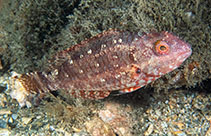
Dorsal spines (total): 9-9; Dorsal soft rays (total): 10-10; Anal spines: 3-3; Anal soft rays: 9-9. Front of upper jaw has horizontal canine-like tusks. 2 scales between bases of pelvic fins (Ref. 26938). Drab-phase fish are olivaceous to yellowish brow, finely speckled with pale dots, many are conjoined; base and axil of pectoral fins broadly blue-green. Terminal-phase males are greenish brown with faint pale dots, some scales with reddish edges; irregular orange-red markings on opercle; a blackish bar at pectoral base; a broad blackish border posteriorly on caudal fin (Ref. 13442). |
| Biology: |
Mostly found in seagrass beds in shallow, protected waters. Feeds primarily on epiphytes and seagrass blades, leaving crescent bite marks. Darts into seagrass when frightened (Ref. 9710). |
| IUCN Red List Status: |
Least Concern (LC); Date assessed: 13 June 2008 Ref. (130435)
|
| Threat to humans: |
reports of ciguatera poisoning |
Source and more info: www.fishbase.org. For personal, classroom, and other internal use only. Not for publication.