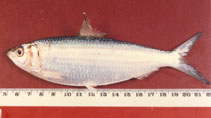
| Family: |
Dorosomatidae (Gizzard shads and sardinellas) |
| Max. size: |
Deprecated: strlen(): Passing null to parameter #1 ($string) of type string is deprecated in /var/www/html/FieldGuide/FieldGuideSummary.php on line 600
Deprecated: strlen(): Passing null to parameter #1 ($string) of type string is deprecated in /var/www/html/FieldGuide/FieldGuideSummary.php on line 616
19 cm TL (male/unsexed) |
| Environment: |
pelagic-neritic; brackish; marine; depth range 0 - 50 m |
| Distribution: |
Indo-West Pacific: from Kuwait to southern India and Bay of Bengal to the Philippines, also eastern tip of Papua New Guinea. Often confused with Sardinella gibbosa in Indian waters. |
| Diagnosis: |
Dorsal spines (total): 0-0; Dorsal soft rays (total): 18-19; Anal spines: 0-0; Anal soft rays: 18-20. This species is distinguished by the following characters: deep body, its depth 28·0-33·2% SL; interrupted longitudinal striae formation in lateral scales; scutes prepelvic and post-pelvic 17-18 + 11-12, respectively, oftern 18 + 12; A 18-20 rays, usually 19; lower gill rakers 65-81 (Ref. 114969). |
| Biology: |
Forms schools in coastal waters. Misidentifications (especially with S. gibbosa in Indian waters and S. albella in the western Indian Ocean) make published biological data potentially unreliable. Marketed fresh, dried-salted, boiled or made into fish balls. |
| IUCN Red List Status: |
Least Concern (LC); Date assessed: 02 March 2018 Ref. (130435)
|
| Threat to humans: |
harmless |
Source and more info: www.fishbase.org. For personal, classroom, and other internal use only. Not for publication.