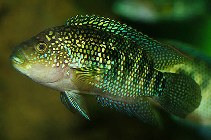
| Family: |
Cichlidae (Cichlids), subfamily: Cichlasomatinae |
| Max. size: |
Deprecated: strlen(): Passing null to parameter #1 ($string) of type string is deprecated in /var/www/html/FieldGuide/FieldGuideSummary.php on line 600
Deprecated: strlen(): Passing null to parameter #1 ($string) of type string is deprecated in /var/www/html/FieldGuide/FieldGuideSummary.php on line 616
25 cm TL (male/unsexed) |
| Environment: |
benthopelagic; freshwater; pH range: 7 - 8; dH range: 9 - 20, non-migratory |
| Distribution: |
North and Central America: Atlantic slope from southern Mexico (Papaloapán River) to Honduras (Ulua River). |
| Diagnosis: |
Dorsal spines (total): 17-19; Dorsal soft rays (total): 8-10; Anal spines: 8-9; Anal soft rays: 7-9. This species has spots on sides smaller than scales, aligned in about 15 regular series (vs. not clearly aligned); abdomen predominantly whitish or greyish in life (similar to R. gemmata, vs. reddish in R. ocotal; ventral angle of articular is acute (vs. right); the first neural spine oriented rostrad (vs. caudad); circumpeduncular scales as few as 17 (vs. always more than 19); distance from the caudal esophageal loop in gut to esophagus always greater than 24% gut length (vs. less than 16%) (Ref. 74403).
There are no unique autapomorphies. |
| Biology: |
Adults occur in swampy areas with warm, murky water. They are found in weedy, mud-bottomed and sand-bottomed canals and drainage ditches (Ref. 5723). They prefer coastal plains and slow moving waters of the lower river valleys (Ref. 7335). Food consists of worms, crustaceans, insects and fish (Ref. 7020). |
| IUCN Red List Status: |
Least Concern (LC); Date assessed: 24 August 2018 Ref. (130435)
|
| Threat to humans: |
harmless |
Source and more info: www.fishbase.org. For personal, classroom, and other internal use only. Not for publication.