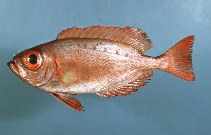
| Family: |
Priacanthidae (Bigeyes or catalufas) |
| Max. size: |
Deprecated: strlen(): Passing null to parameter #1 ($string) of type string is deprecated in /var/www/html/FieldGuide/FieldGuideSummary.php on line 616
50 cm TL (male/unsexed); max.weight: 2,850.0 g |
| Environment: |
reef-associated; marine; depth range 10 - 200 m |
| Distribution: |
Tropical and tropically influenced areas of the Atlantic Ocean. Western Atlantic: Canada (Ref. 5951) to Bermuda and at least North Carolina, USA (Ref. 5403) southward to northern Argentina (Ref. 3800). Eastern Atlantic: Madeira to Namibia. Mediterranean (Ref. 50345). Reports from the Indo-Pacific are misidentifications. |
| Diagnosis: |
Dorsal spines (total): 10-10; Dorsal soft rays (total): 14-14; Anal spines: 3-3; Anal soft rays: 15-15 |
| Biology: |
Found on coral reefs and rocky bottoms (Ref. 3800). Forms small aggregations near the bottom (Ref. 10786). A nocturnal feeder (Ref. 5521), feeds mainly on small fishes, crustaceans and polychaetes (Ref. 3800). Most of its prey are larvae. Flesh considered excellent quality; marketed fresh (Ref. 5217). |
| IUCN Red List Status: |
Least Concern (LC); Date assessed: 29 January 2013 Ref. (130435)
|
| Threat to humans: |
reports of ciguatera poisoning |
Source and more info: www.fishbase.org. For personal, classroom, and other internal use only. Not for publication.