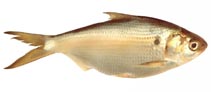
| Family: |
Dorosomatidae (Gizzard shads and sardinellas) |
| Max. size: |
Deprecated: strlen(): Passing null to parameter #1 ($string) of type string is deprecated in /var/www/html/FieldGuide/FieldGuideSummary.php on line 600
Deprecated: strlen(): Passing null to parameter #1 ($string) of type string is deprecated in /var/www/html/FieldGuide/FieldGuideSummary.php on line 616
36 cm SL (male/unsexed); max. reported age: 20 years |
| Environment: |
pelagic-neritic; brackish; marine, anadromous |
| Distribution: |
Eastern Indian Ocean: endemic to Western Australia. |
| Diagnosis: |
Dorsal spines (total): 0-0; Dorsal soft rays (total): 16-17; Anal spines: 0-0; Anal soft rays: 22-24; Vertebrae: 45-49. Belly with 16 to 19 (usually 18) + 12 to 14 (usually 12), total 28 to 32 (usually 31) scutes. Anterior arm of pre-operculum with a fleshy triangular area above, not covered by third infra-orbital bone (see N. come). Lower jaw strongly flared outward. A small pectoral axillary scale present. Hind edge of scales toothed. A dark spot behind gill opening. |
| Biology: |
Abundant in estuaries; also found in coastal embayments. A filter-feeder. Eggs and larvae are pelagic (Ref. 33617). Used mainly for bait in the rock lobster fishery in Western Australia (Ref. 33617). |
| IUCN Red List Status: |
Least Concern (LC); Date assessed: 28 February 2017 Ref. (130435)
|
| Threat to humans: |
harmless |
Source and more info: www.fishbase.org. For personal, classroom, and other internal use only. Not for publication.