
|
Lepidotrigla longipinnis Alcock, 1890 Stellar gurnard |
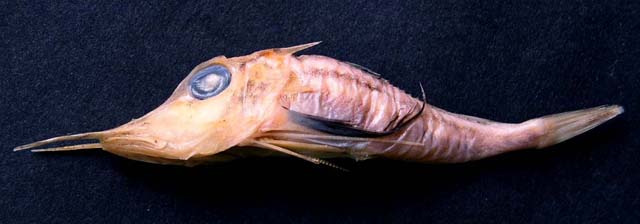
|
|
photo by
A. Biju Kumar |
| Family: | Triglidae (Searobins), subfamily: Triglinae | |||
| Max. size: | 11.7 cm SL (male/unsexed) | |||
| Environment: | demersal; marine; depth range 70 - 107 m | |||
| Distribution: | Indian Ocean: India, Myanmar and Indonesia. | |||
| Diagnosis: | Dorsal spines (total): 8-9; Dorsal soft rays (total): 15-16; Anal soft rays: 15-15; Vertebrae: 30-32. This species can be distinguished from by the following characters: the lateral profile of body with gradual convexly curved taper to caudal peduncle; with a distinctive postorbital notch above and behind each eye but not extending across top of head as occipital groove; when viewed above, rostral process with broad obtuse angle or straight and with prominent forward directed blade-like spine at each corner often mounted on somewhat triangular base; scales are moderately adherent; pored lateral line scales 56-61; scales above lateral line 3 and below 13-15 oblique scale rows; D1 VIII-IX, D2 15-16; A 15 (rarely 14 or 16); pectoral fin reaching fifth to seventh anal fin ray. Colouration: caudal fin mostly red with white transverse band near base; inner surface of pectoral fin with a large black oblong patch ventrally superimposed with scattered pale blue spots, the rest greenish with reddish margins dorsally, ventrally and basally (Ref. 127939). | |||
| Biology: | ||||
| IUCN Red List Status: | Data deficient (DD); Date assessed: 21 June 2017 Ref. (130435) | |||
| Threat to humans: | harmless | |||