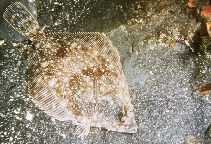
| Family: |
Pleuronectidae (Righteye flounders), subfamily: Pleuronectinae |
| Max. size: |
Deprecated: strlen(): Passing null to parameter #1 ($string) of type string is deprecated in /var/www/html/FieldGuide/FieldGuideSummary.php on line 616
58 cm TL (male/unsexed); 60 cm TL (female); max.weight: 1,800.0 g; max. reported age: 26 years |
| Environment: |
demersal; marine; depth range 0 - 575 m |
| Distribution: |
North Pacific: Baja California to the eastern Aleutian Islands and extreme southeastern Bering Sea. |
| Diagnosis: |
Dorsal spines (total): 0-0; Dorsal soft rays (total): 65-82; Anal spines: 0-0; Anal soft rays: 50-65; Vertebrae: 39-42. Dorsal origin over forward part of eye. Caudal with posterior margin a broad 'V'. Pectorals small and may be asymmetrical (Ref. 6885). Blind side white, with glossy highlights along myotome margins, increasing anteriorly. Pores: supraorbital 3-9; preopercular 5-7; lateral line 70-91. Interorbital space narrow (Ref. 37594). |
| Biology: |
Adults occur over sand and gravel substrates to depths of 339 m; larvae collected over depths less than 1,000 m (Ref. 37594). Feed on mollusks, polychaete worms, crustaceans, brittle stars, and fishes (Ref. 6885). A tasty food fish; in some years commercial catch in Canada reaches 3,000 t (Ref. 2850). |
| IUCN Red List Status: |
Least Concern (LC); Date assessed: 13 August 2020 Ref. (130435)
|
| Threat to humans: |
harmless |
Source and more info: www.fishbase.org. For personal, classroom, and other internal use only. Not for publication.