| Family: |
Acestrorhamphidae (American tetras), subfamily: Hyphessobryconinae |
| Max. size: |
Deprecated: strlen(): Passing null to parameter #1 ($string) of type string is deprecated in /var/www/html/FieldGuide/FieldGuideSummary.php on line 600
Deprecated: strlen(): Passing null to parameter #1 ($string) of type string is deprecated in /var/www/html/FieldGuide/FieldGuideSummary.php on line 616
3.17 cm SL (male/unsexed) |
| Environment: |
benthopelagic; freshwater |
| Distribution: |
South America: Brazil. |
| Diagnosis: |
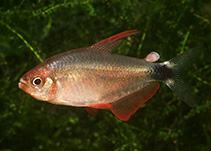
Dorsal soft rays (total): 9-9; Anal soft rays: 19-24. This species is distinguished from all congeners, except with H. elachys, H. heliacus, H. loweae, by having a conspicuously elongated and filamentous dorsal fin in mature males (vs. dorsal and pelvic fins, when elongated, never filamentous), by its overall red color when alive (vs. a general clear/silvery color in elachys and golden color in heliacus, loweae); further differs from elachys by having a straight margin of anal fin in mature males (vs. a distinctly rounded anal-fin lobe elachys ); differs from heliacus by having a shorter pelvic-fins in fully mature males, reaching only the second anal-fin branched ray (vs. pelvic-fins filamentous, reaching to the sixth anal-fin branched ray) and by lacking chevron-like dark markings along the midline (vs. chevron-like dark markings along the midline present); differs from loweae by having a lower number of horizontal scale rows between the dorsal-fin origin and the lateral line 5 (vs.6-7) and by the higher number of branched anal-fin rays 21-24, modally 22 (vs. 17-21, modally 20) (Ref. 93222). |
| Biology: |
|
| IUCN Red List Status: |
Least Concern (LC); Date assessed: 07 November 2018 Ref. (130435)
|
| Threat to humans: |
harmless |
Source and more info: www.fishbase.org. For personal, classroom, and other internal use only. Not for publication.