| Family: |
Carangidae (Jacks and pompanos), subfamily: Caranginae |
| Max. size: |
Deprecated: strlen(): Passing null to parameter #1 ($string) of type string is deprecated in /var/www/html/FieldGuide/FieldGuideSummary.php on line 600
Deprecated: strlen(): Passing null to parameter #1 ($string) of type string is deprecated in /var/www/html/FieldGuide/FieldGuideSummary.php on line 616
60 cm TL (male/unsexed) |
| Environment: |
benthopelagic; marine; depth range 60 - 100 m, oceanodromous |
| Distribution: |
Eastern Pacific: southern Baja California, Mexico to Ecuador and the Galapagos Islands. |
| Diagnosis: |
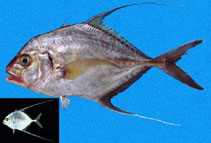
Body compressed and sub-oval in juveniles, oblong in adults; dorsal profile of snout slightly oblique, then abruptly vertical over anterior edge of premaxilla; lobes of second dorsal and anal fins very long; ventral part of chest scaleless up to origin of pectoral fins; body silvery blue with yellow golden highlights; dorsal side of operculum with a black spot; base of second dorsal fin membranes with small black spots (Ref. 55763). |
| Biology: |
Adults are found in oceanic waters (Ref. 9283). Marketed fresh and salted or dried (Ref. 9283). |
| IUCN Red List Status: |
Least Concern (LC); Date assessed: 01 May 2008 Ref. (130435)
|
| Threat to humans: |
harmless |
Source and more info: www.fishbase.org. For personal, classroom, and other internal use only. Not for publication.