| Family: |
Lutjanidae (Snappers), subfamily: Etelinae |
| Max. size: |
Deprecated: strlen(): Passing null to parameter #1 ($string) of type string is deprecated in /var/www/html/FieldGuide/FieldGuideSummary.php on line 616
100 cm TL (male/unsexed); max.weight: 6,280.0 g |
| Environment: |
bathydemersal; marine; depth range 100 - 450 m |
| Distribution: |
Western Atlantic: Bermuda and North Carolina, USA, Gulf of Mexico southward through the Caribbean to Sau Paulo, Brazil (Ref. 55), including the Fernando do Noronha and Atol das Rocas Islands (Ref. 113956). |
| Diagnosis: |
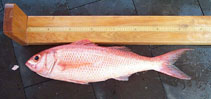
Dorsal spines (total): 10-10; Dorsal soft rays (total): 11-11; Anal spines: 3-3; Anal soft rays: 8-8. Head small; eye large; snout short. Maxilla covered with small scales; lower jaw slightly projecting. Dorsal and anal fin bases without scales; caudal fin deeply forked. Scale rows on the back running parallel with the lateral line. Back and upper sides deep pink to red; lower sides and belly pink; fins pink except the spinous portion of the dorsal fin; entire caudal fin brilliant red. |
| Biology: |
Adults inhabit rocky bottoms and feeds mainly on small fishes and squids. They are abundant near oceanic islands (Ref. 9626). Small individuals are taken as by-catch in trawl fisheries (Ref. 5217). Marketed mostly fresh, sometimes frozen. Flesh of good quality. |
| IUCN Red List Status: |
Data deficient (DD); Date assessed: 10 October 2015 Ref. (130435)
|
| Threat to humans: |
harmless |
Source and more info: www.fishbase.org. For personal, classroom, and other internal use only. Not for publication.