
|
Dajaus monticola (Bancroft, 1834) Mountain mullet |
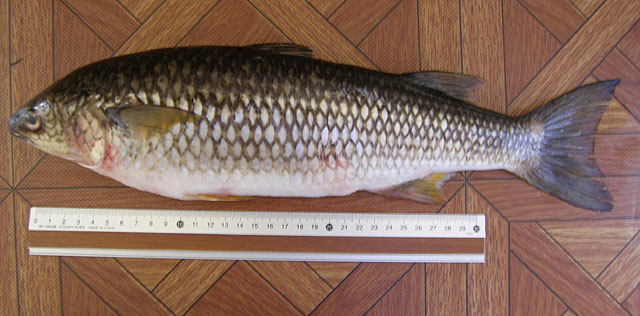
|
|
photo by
Molina, A. |
| Family: | Mugilidae (Mullets) | |||
| Max. size: | 36 cm TL (male/unsexed) | |||
| Environment: | pelagic-neritic; freshwater; brackish; marine, catadromous | |||
| Distribution: | Western Atlantic: North Carolina to Texas in the USA south to Venezuela, including the West Indies. | |||
| Diagnosis: | Dorsal spines (total): 5-5; Dorsal soft rays (total): 8-8; Anal spines: 2-2; Anal soft rays: 9-9 | |||
| Biology: | Adults inhabit pools and runs of small to medium rivers (Ref. 86798). They live in freshwater rivers and streams. Young are encountered occasionally in brackish waters. This is the only mullet that ascends far inland and spends all its adult life in freshwater (Ref. 11225). Tend to be few and solitary in upper streams, but form uneven schools in larger streams at lower elevations (Ref. 11225). Oviparous, eggs are pelagic and non-adhesive (Ref. 205). Usually spawn during the rainy season (Ref. 42119). Caught and consumed by local populations in some parts of central America. | |||
| IUCN Red List Status: | Least Concern (LC); Date assessed: 15 January 2019 Ref. (130435) | |||
| Threat to humans: | harmless | |||