| Family: |
Apogonidae (Cardinalfishes), subfamily: Apogoninae |
| Max. size: |
Deprecated: strlen(): Passing null to parameter #1 ($string) of type string is deprecated in /var/www/html/FieldGuide/FieldGuideSummary.php on line 600
Deprecated: strlen(): Passing null to parameter #1 ($string) of type string is deprecated in /var/www/html/FieldGuide/FieldGuideSummary.php on line 616
6 cm TL (male/unsexed) |
| Environment: |
reef-associated; marine; depth range 1 - 65 m, non-migratory |
| Distribution: |
Indo-Pacific: Red Sea south to Inhambane (Ref. 4329) and east to the Hawaiian Islands and Rapa, north to southern Japan; throughout Micronesia. |
| Diagnosis: |
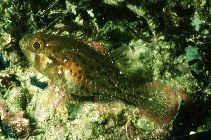
Dorsal spines (total): 8-8; Dorsal soft rays (total): 9-9; Anal spines: 2-2; Anal soft rays: 8-8. Olive brown with irregular dark spots and streaks; speckled fins; normally with a dark line from eye to origin of LL and stripe from eye to angle of preopercle (Ref. 4329, 48635). Developed gill rakers 5-7. A distinctive small white spot centrally at base of caudal fin (Ref. 48635).
Description: Characterized by small eighth spine usually covered by skin; greatest depth of body 2.4-2.6 in SL (Ref. 90102). |
| Biology: |
Adults occur inshore (Ref. 7300). Found among rubble of reef flats and 'dead' reefs (Ref. 1602, 58302). Benthic and benthopelagic (Ref. 58302). Secretive (Ref. 48635), nocturnal species (Ref. 7300). Eggs are incubated orally (Ref. 205). Monogamous and always in home-ranging pairs, that is they do not defend an exclusive territory (Ref. 52884). Minimum depth reported taken from Ref. 57178. |
| IUCN Red List Status: |
Least Concern (LC); Date assessed: 14 August 2023 Ref. (130435)
|
| Threat to humans: |
harmless |
Source and more info: www.fishbase.org. For personal, classroom, and other internal use only. Not for publication.