| Family: |
Cichlidae (Cichlids), subfamily: Cichlasomatinae |
| Max. size: |
Deprecated: strlen(): Passing null to parameter #1 ($string) of type string is deprecated in /var/www/html/FieldGuide/FieldGuideSummary.php on line 600
Deprecated: strlen(): Passing null to parameter #1 ($string) of type string is deprecated in /var/www/html/FieldGuide/FieldGuideSummary.php on line 616
16 cm TL (male/unsexed) |
| Environment: |
benthopelagic; freshwater; pH range: 6.5 - 8; dH range: 25, non-migratory |
| Distribution: |
Central and South America: Trinidad and Venezuela. |
| Diagnosis: |
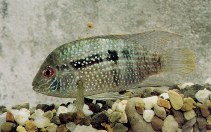
Anal spines: 3-3. Aequidens is very similar to Geophagus but is differentiated by the number of spines on the anal fin and the lacks of a lobule on the first branchial arch found in Geophagus; live specimens olive green, with eight obscure transverse bands on the body; numerous bright bluish-green lines on the cheek; males are more colorful and grow bigger than females; males blue in color during the reproductive season (Ref. 26543). |
| Biology: |
Adults inhabit turbid standing waters as well as clear free flowing streams (Ref. 11225). They feed on worms, crustaceans and insects (Ref. 7020). Reproduces in captivity (Ref. 26543). Both parents guard the eggs and larvae (Ref. 7020). Utilized to control mosquito larvae (Ref. 40602). Aquarium keeping: in pairs; minimum aquarium size 100 cm (Ref. 51539). |
| IUCN Red List Status: |
Least Concern (LC); Date assessed: 03 April 2020 Ref. (130435)
|
| Threat to humans: |
harmless |
Source and more info: www.fishbase.org. For personal, classroom, and other internal use only. Not for publication.