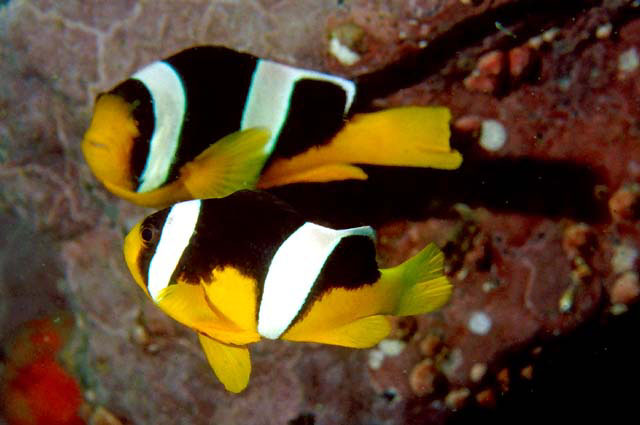
| Pomacentridae (Damselfishes), subfamily: Pomacentrinae |
Deprecated: strlen(): Passing null to parameter #1 ($string) of type string is deprecated in /var/www/html/FieldGuide/FieldGuideSummary.php on line 600
Deprecated: strlen(): Passing null to parameter #1 ($string) of type string is deprecated in /var/www/html/FieldGuide/FieldGuideSummary.php on line 616
16 cm TL (male/unsexed) |
|
reef-associated; marine; depth range 2 - 25 m, non-migratory |
| Indian Ocean: Arabian Peninsula, India, Sri Lanka, Maldives, Andaman Islands, and Sumatra and Java in Indonesia. |
|
Dorsal spines (total): 10-11; Dorsal soft rays (total): 14-17; Anal spines: 2-2; Anal soft rays: 13-14. Description: Often all yellow or has a yellow band. In Bali, they are mostly black (Ref. 48636). Body depth 2.0-2.2 in SL (Ref. 90102). |
| Found in coastal waters and lagoons. They grow rather large (Ref. 48636). Oviparous, distinct pairing during breeding (Ref. 205). Eggs are demersal and adhere to the substrate (Ref. 205). Males guard and aerate the eggs (Ref. 205). Associated with the anemone Stichodactyla haddoni (Ref. 5911). Diurnal species (Ref. 113699). |
|
Least Concern (LC); Date assessed: 01 August 2021 Ref. (130435)
|
| harmless |
Source and more info: www.fishbase.org. For personal, classroom, and other internal use only. Not for publication.